

Why Drink Freshly Roasted Coffee Beans? A 2026 Guide
Table of Contents
- Why Freshly Roasted Coffee Beans Taste Better
- Coffee Degassing Process Explained: What Happens After Roasting
- How Long Should You Wait to Brew After Roasting?
- How to Tell If Coffee Beans Are Fresh
- How to Store Coffee Beans for Freshness
- Roast Level, Decaf, and Environmental Factors That Change Resting Time
- What Freshness Really Means for Your Cup
- Frequently Asked Questions
Last Updated: September 12, 2026
Why Freshly Roasted Coffee Beans Taste Better
Freshly roasted coffee tastes better because the volatile oils and aromatic compounds that define its flavor are still intact and active. This guide from Coffee Depot breaks down why that window matters, and how to hit it every time.
Here's the core tension most guides skip: freshness is not a single moment, it's a curve. Coffee is at its worst immediately after roasting, peaks in the middle, then declines. Understanding that curve is the entire game.
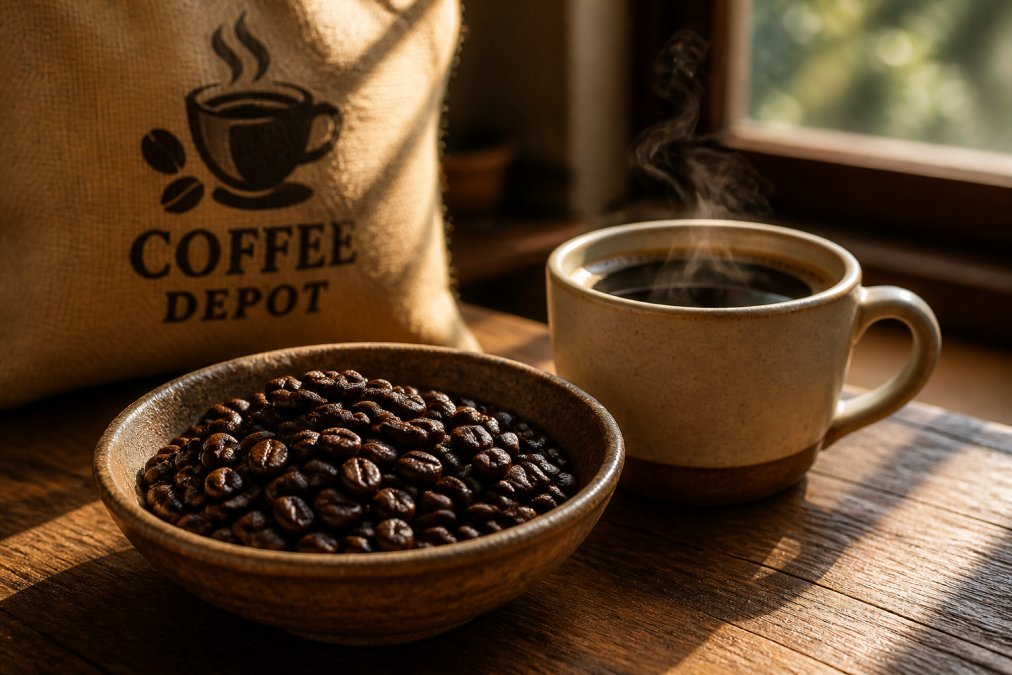
The Role of Carbon Dioxide in Flavor
Carbon dioxide is the gas trapped inside a coffee bean during roasting, and it's the biggest reason fresh coffee behaves differently. As the bean cools, that CO2 escapes, a process called degassing or off-gassing.
While CO2 is still pouring out, it interferes with water's ability to reach the soluble compounds you want, producing an uneven, sometimes sour or flat cup even from excellent beans. The bean's porous cell structure releases gas that pushes water away from the good stuff.
This is why a bag of coffee roasted two days ago can taste worse than one roasted ten days ago. Freshness and peak flavor are not the same thing.
Coffee Degassing Process Explained: What Happens After Roasting
The coffee degassing process is the gradual release of carbon dioxide and other gases from roasted beans over days and weeks, starting the moment roasting ends and slowing as internal pressure drops.
Roasting transforms green coffee through heat, expanding the bean and building internal pressure. For the first few days after the roast, CO2 escapes rapidly; then the rate slows and the bean settles into a stable window where extraction becomes predictable.
The roast date on the bag is your anchor point. It tells you where a bean sits on that curve, which matters far more than any "best by" date printed months out.
How Long Should You Wait to Brew After Roasting?
Most coffee reaches its brew window between 4 and 14 days after the roast date, depending on roast level and brewing method (peer-reviewed research). There's no universal number.
The resting period exists because you're waiting for degassing to slow enough that water can extract evenly. Too early, CO2 blocks extraction; too late, oxidation steals the aromatic compounds that made the coffee special.
Resting Times by Brewing Method
Different brewing methods tolerate and even demand different resting periods. Espresso is the most sensitive; pour-over and immersion methods are more forgiving.
| Brewing Method | Ideal Resting Period | Why It Differs |
|---|---|---|
| Espresso | 7-14 days | High pressure amplifies CO2 interference and channeling |
| Pour-over | 4-10 days | Bloom step releases trapped gas before main extraction |
| French press | 5-12 days | Full immersion, slower extraction, more forgiving |
| Cold brew | 3-7 days | Long steep time neutralizes most CO2 issues |
| Drip | 5-12 days | Moderate pressure, moderate sensitivity |
The bloom you see when hot water hits fresh grounds is CO2 escaping. A large, aggressive bloom usually signals a bean that's still young. A small, quiet bloom suggests it's rested or, in the worst case, already staling.
How to Tell If Coffee Beans Are Fresh
Most guides hand you a checklist and stop there. A checklist tells you fresh versus stale, but not where a bean sits on the degassing curve, and a bean can be objectively fresh and still two days from its peak. Here is a sensory protocol that locates the window.
The Four Baseline Signals
Start with the cheap, fast checks. They rule out obviously stale coffee before you waste a brew.
- Roast date: The most reliable single indicator. Look for a printed roast date, not a "best by" date. A "best by" date is typically set 9 to 12 months out and tells you almost nothing about when the beans were roasted (usda.gov).
- Bloom: Fresh beans swell and bubble aggressively when hit with hot water. A flat, quiet bed is a warning sign.
- Aroma: Fresh beans smell sweet, complex, and alive. Stale beans smell flat, papery, or like cardboard.
- Surface oils: Dark roasts show oils within days of roasting. If a dark roast looks matte and dry on arrival, it has likely been sitting.
Those four get you to "probably fine." They do not get you to peak.
The Peak-Window Protocol
Instead of guessing, run a controlled taste test across the resting window and let your palate find the peak.
Step 1, Fix every variable except time. Use the same dose, grind setting, water temperature, and brew method for every test. Change two things at once and you learn nothing.
Step 2, Brew on a schedule. Pull a cup on day 2, 5, 8, 11, and 14 after the roast date. Five data points reveal the shape of the curve without turning your kitchen into a lab.
Step 3, Score four attributes on a simple 1-5 scale.
| Attribute | What early (gassy) looks like | What peak looks like | What past-peak looks like |
|---|---|---|---|
| Acidity | Sharp, prickly, sometimes sour | Bright but balanced | Dull, muted |
| Sweetness | Hidden behind the gas | Forward and rounded | Fading |
| Body | Thin, watery | Syrupy, coating | Hollow |
| Finish | Short, sometimes metallic | Long, clean | Papery, drying |
Step 4, Find the crossover. The peak is the cup where acidity stops being sharp and sweetness and body are both at their highest. In practice, most drinkers find that point lands somewhere between day 6 and day 10 for a medium roast, earlier for dark, later for light.
Step 5, Watch the bloom as a leading indicator. A large, aggressive bloom usually means the bean is still young; as it approaches peak, the bloom shrinks and settles faster. When the bloom goes quiet and the cup tastes flat at once, you've passed the window.
What the Signals Cannot Tell You
Two caveats matter. First, surface oils signal roast level, not freshness, a light roast can be perfectly fresh and still look matte. Second, bag aroma is unreliable because it depends on how long the bag has been open and how it was stored. Trust the cup, not the bag.
How to Store Coffee Beans for Freshness
Learning how to store coffee beans for freshness comes down to four enemies: oxygen, light, heat, and moisture. Beat all four and you extend the brew window considerably. Storage controls how fast beans move along the degassing curve, store them wrong and you can push a bean past its peak before you open the bag.
The Four Enemies, and What Each One Actually Does
- Oxygen oxidizes the aromatic oils that carry a coffee's distinctive notes, the primary driver of staling, accelerating once the bag is opened.
- Light breaks down those same oils, which is why opaque packaging matters, a clear glass jar on a sunny counter works against you.
- Heat speeds up every chemical reaction, including oxidation. A bag next to the stove ages faster than one in a cool pantry.
- Moisture degrades the bean and encourages mold, and is why the freezer is a trap for daily-use beans.
The Practical Setup
- Keep beans in an airtight container, ideally opaque and ceramic or stainless steel.
- Store at room temperature, away from the stove, oven, or any heat source.
- Keep them whole and grind right before brewing. Grinding exposes far more surface area to oxygen, and the staling clock runs much faster on ground coffee.
- Skip the freezer for daily-use beans. Condensation from repeated thawing does more damage than it prevents.
- Buy in quantities you'll finish within a few weeks rather than stockpiling.
Valve packaging matters: one-way degassing valves let CO2 escape without letting oxygen in, which is why good roasters use them. Once you open the bag, transfer to an airtight container and use it within two to three weeks.
How Roast Level Changes the Storage Clock
Storage advice isn't one-size-fits-all, because roast level changes how fast a bean degasses and oxidizes.
- Dark roasts are more porous and degas faster, hitting their brew window in 3 to 5 days, but they oxidize faster too, so buy them in smaller quantities.
- Light roasts are denser, hold CO2 longer, and typically need 7 to 14 days to hit their stride. They also store better, so light-roast drinkers can buy larger bags.
- Decaf follows a different curve: decaffeination alters the bean's structure before roasting, so many roasters find decaf degasses more quickly and tastes flat sooner. Buy smaller quantities more often.
Environmental Factors Most Guides Ignore
Humidity, altitude, and ambient temperature all shift how fast beans release gas and oxidize, the quiet variable that makes generic resting advice unreliable.
- Humidity: Beans are hygroscopic and absorb moisture from the air, so in a humid climate they stale faster and the brew window narrows. A tight-sealing container matters more, not less.
- Altitude: At higher elevations, lower air pressure lets gases escape more readily, so beans can degas faster than at sea level, shifting the peak window earlier (peer-reviewed research).
- Ambient temperature: A warm kitchen accelerates degassing and oxidation; a cool, stable pantry slows both. A resting recommendation that works in one kitchen may not transfer to another.
Treat any resting recommendation as a starting point, not a rule. Adjust based on your roast level, your climate, and what your own cup tells you.
Roast Level, Decaf, and Environmental Factors That Change Resting Time
What Freshness Really Means for Your Cup
Coffee's flavor profile develops across its resting period. Early on, sharp acidity and a thin body appear as CO2 disrupts extraction. Mid-window, sweetness, body, and distinctive notes come forward. Past the window, oxidation brings flatness, papery notes, and dulled acidity.
The throughline: chasing freshly roasted coffee isn't about drinking it the day it's roasted. It's about understanding the curve, knowing where your beans sit on it, and brewing inside the window where they perform best.
For anyone who wants that window handled for them, this is exactly where Coffee Depot fits. Coffee isn't brewed until you order it, then it ships directly to you, so the roast date is genuinely recent rather than a warehouse guess. If you're not sure which roast suits your setup, the Best Sellers Sample Pack at $24.99 lets you test six blends before committing, and the Single Origin Favorites Sample Pack at $24.99 covers the single-origin side. Every item sold also sends $1 to charity.


Frequently Asked Questions
How long should you wait to drink freshly roasted coffee?
Most coffees taste best 4 to 14 days after the roast date. Espresso often needs 5 to 10 days of resting so carbon dioxide can escape and extraction stabilizes. Pour-over and drip brewers can work well at 3 to 7 days. Very dark roasts degas faster and may peak sooner, while light roasts can keep improving for two to three weeks. The bag's roast date, not the purchase date, is your reference point.
Are freshly roasted coffee beans better than pre-ground coffee?
Yes, for flavor and aroma. Whole beans roasted recently retain volatile oils and aromatic compounds that pre-ground coffee loses quickly. Grinding exposes more surface area to oxygen, speeding up staling. If you buy freshly roasted coffee and grind right before brewing, you preserve solubility, body, and the notes that define each origin. Pre-ground coffee can still taste fine, but it has a shorter shelf life once opened.
What is the 15-15-15 rule for coffee?
The 15-15-15 rule is a simple freshness guideline: buy coffee within 15 days of the roast date, store it in an airtight container away from light and heat, and brew within 15 minutes of grinding. Some versions also mention keeping brewed coffee for no more than 15 minutes before drinking. The exact numbers vary by source, but the principle is sound: shorter time between roast, grind, and brew means better flavor.
How does oxidation affect the flavor of roasted coffee?
Oxidation happens when oxygen reacts with the volatile oils and aromatic compounds in roasted beans. Over time, this process dulls acidity, flattens body, and introduces stale or cardboard-like notes. Beans stored in valve packaging or airtight containers slow oxidation, while beans left open to air lose peak flavor within days. Knowing how to store coffee beans for freshness is the most direct way to slow oxidation and protect the flavor profile.
The hardest part of fresh coffee isn't finding good beans. It's timing the brew window before it closes, which is nearly impossible when you don't know the roast date. Coffee Depot roasts to order, ships direct, and donates $1 from every item sold to charity, so you get beans inside their peak window instead of guessing. Start with a sample pack, find the roast you love, and reorder it whenever you like.