

How to Tell If Coffee Beans Are Fresh
Table of Contents
- Why Fresh Coffee Beans Make or Break Your Cup
- The Coffee Roast Date Meaning and Why It Matters
- How to Tell If Coffee Beans Are Fresh: 5 Tests to Run at Home
- The Coffee Degassing Process Explained
- How Grinding Accelerates Freshness Decay
- How to Store Coffee Beans for Maximum Shelf Life
- Troubleshooting Brewing Variables Tied to Stale Beans
- Conclusion
Last Updated: August 11, 2026
Why Fresh Coffee Beans Make or Break Your Cup
Fresh coffee beans separate a transcendent cup from a flat, forgettable one. No brewing technique or equipment can rescue beans that have lost their volatile aromatic compounds and carbon dioxide. At Coffee Depot, we've built our entire model around this reality: coffee roasted until you order it arrives at peak freshness, not weeks into its shelf life. Understanding how to tell if coffee beans are fresh is the foundation of every great cup you'll ever brew.
The good news: you don't need lab equipment. Your nose, eyes, and a kettle of hot water are enough to run reliable freshness tests.
The Coffee Roast Date Meaning and Why It Matters
The roast date is the single most important piece of information on a bag of coffee. It tells you when beans were transformed from green to roasted, marking when the freshness clock starts.
Most specialty roasters recommend brewing beans between 7 and 21 days after the roast date. Before day 7, beans are still off-gassing carbon dioxide, which can interfere with extraction. After about 4 weeks, oxidation has flattened the flavor profile considerably.
Don't confuse the roast date with a "best by" date. Best-by dates on commodity coffee are often set 12 to 18 months out, technically safe but misleading about quality. A bag roasted 6 months ago won't taste like freshly roasted coffee.
How to Tell If Coffee Beans Are Fresh: 5 Tests to Run at Home
Five practical tests help you assess freshness before or during brewing.
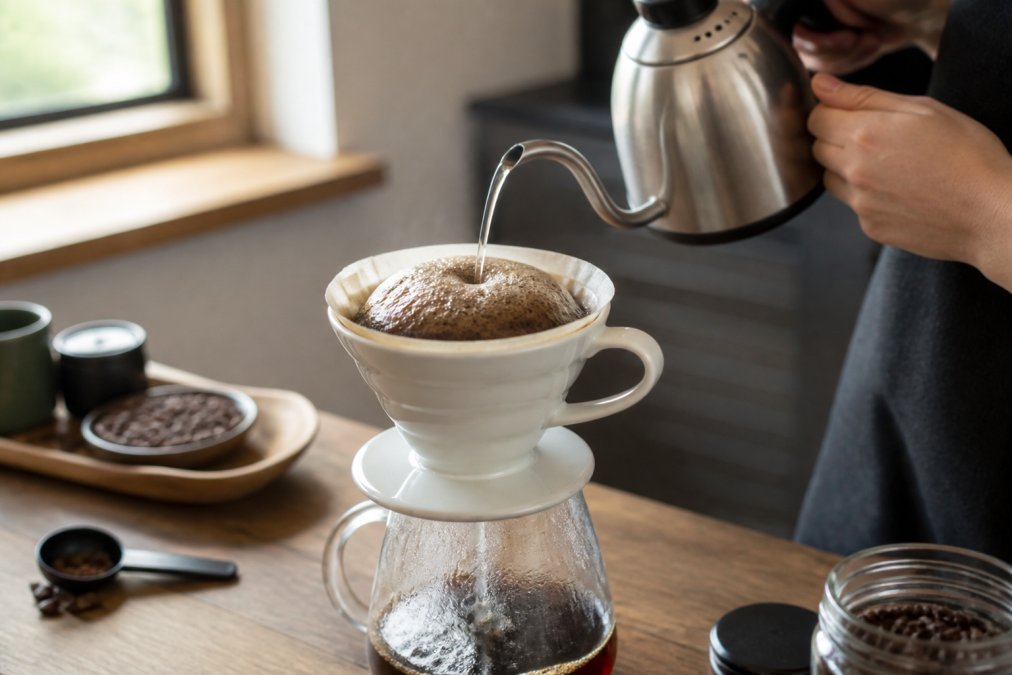
The Bloom Test: Your Most Reliable Freshness Check
The bloom test is the most reliable way to assess freshness at home. Add ground coffee to a pour-over or French press, then pour just enough hot water to saturate the grounds, roughly twice the weight of the coffee. Wait 30 to 45 seconds and watch.
Fresh beans bloom dramatically. Carbon dioxide trapped during roasting escapes rapidly when it contacts hot water, creating a visible, foamy dome. The more vigorous the bloom, the fresher the coffee. According to the Specialty Coffee Association's brewing resources, proper degassing during the bloom phase is essential for even extraction.
Stale beans produce little to no bloom. The CO2 has already escaped, so hot water simply saturates the grounds with no visible reaction.
Aroma and Scent Analysis
Open the bag and take a deliberate inhale. Fresh coffee has complex, layered aroma: fruit, chocolate, nuts, floral notes, or roasty depth depending on origin and roast level. The scent should be vivid and immediately engaging.
Stale coffee smells flat, musty, or faintly cardboard-like, the scent of oxidation. If the aroma doesn't make you want to brew immediately, the beans have likely been sitting too long.
Visual Inspection: Oily Residue vs. Dry Beans
Surface appearance indicates roast level and, to a lesser extent, freshness. Dark roasts naturally produce oily beans because high roasting temperatures cause oils to migrate to the surface. A glossy surface on a dark roast is normal.
Light or medium roast beans that look oily may indicate age, as oils have had time to migrate and oxidize. For any roast level, look for consistent sheen rather than splotchy discoloration or visible moisture condensation.
Taste Profile Indicators
Stale coffee has a distinctive character: flat body, muted flavor, and lingering bitterness or sourness that feels hollow. Fresh coffee has vibrant body with distinct flavor notes matching its origin.
Pay attention to the finish. Fresh coffee leaves a pleasant aftertaste that evolves over seconds. Stale coffee leaves an abrupt, papery, or metallic finish with no lingering complexity.
The CO2 Bag Test: A Simple Home Check
If your coffee bag has a one-way valve, squeeze it firmly and hold it near your face. Fresh beans emit a noticeable burst of CO2-rich gas with strong roasted coffee aroma. Bags with little gas release contain beans well into their aging window.
For a more deliberate test, seal a small quantity of beans in a zip-lock bag overnight. If the bag has puffed up noticeably by morning, the beans are still actively off-gassing, a strong freshness indicator.
The Coffee Degassing Process Explained
The coffee degassing process is the gradual release of carbon dioxide that roasted beans produce as a natural byproduct of roasting. Understanding this explains why freshness testing works.
During roasting, organic compounds break down and recombine, generating significant CO2. This gas is trapped within the bean's porous structure immediately after roasting. Over days and weeks, CO2 slowly escapes. This is why one-way valve bags exist: they allow CO2 to escape without letting oxygen in. Oxygen accelerates oxidation and flavor degradation.
As noted in UC Davis Coffee Center research on roasted coffee chemistry, degassing rate depends on roast level, bean density, and storage temperature. Darker roasts degas faster because roasting breaks down the bean's structure more aggressively. Lighter roasts, with denser structure, degas more slowly and have a longer optimal brewing window.
High-altitude, dense beans retain CO2 longer and hold flavor more effectively than lower-density beans, which is why specialty single-origin coffees from high-altitude regions often taste fresher for longer.
How Grinding Accelerates Freshness Decay
Grinding coffee dramatically accelerates freshness decay. A whole bean has relatively small surface area exposed to oxygen. Grinding shatters it into hundreds of particles, each with exposed surface, increasing total surface exposure by several hundred times.
Ground coffee goes stale many times faster than whole beans. Whole beans stored properly maintain quality for 3 to 4 weeks after roasting. Ground coffee degrades noticeably within 15 to 30 minutes if exposed to air, and within days even when sealed.
Grind immediately before brewing. Coarser grinds have less surface area than fine grinds, so they degrade slightly more slowly, but neither should be pre-ground more than a day in advance.
How to Store Coffee Beans for Maximum Shelf Life
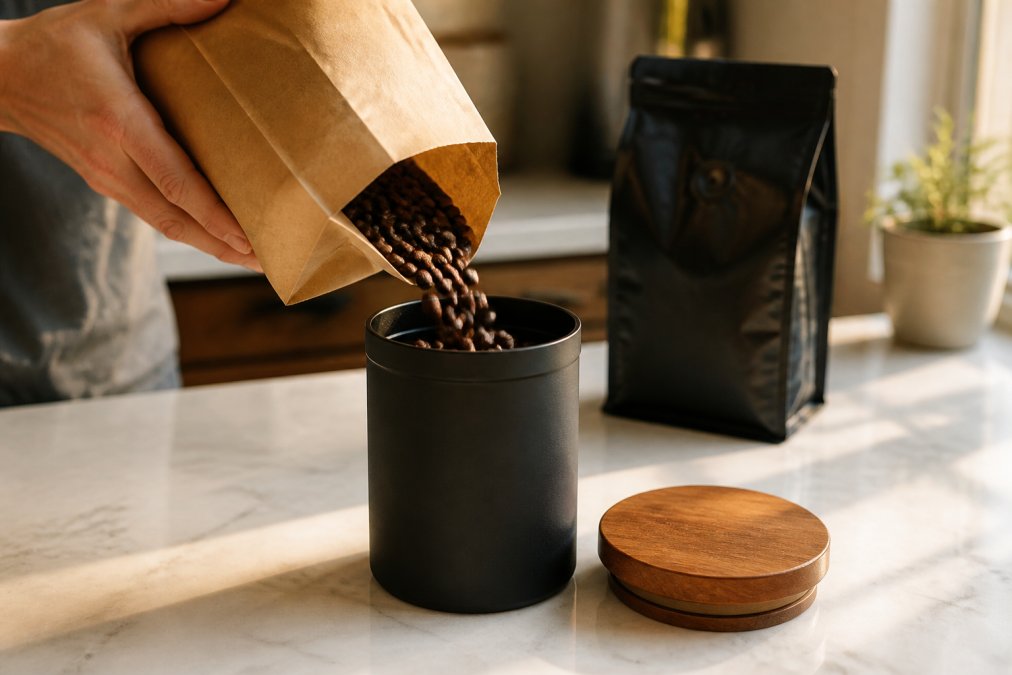
Proper storage is the most controllable variable in preserving freshness. The four enemies are oxygen, light, heat, and moisture.
| Storage Method | Oxygen Protection | Light Protection | Best For |
|---|---|---|---|
| Airtight ceramic canister (opaque) | High | High | Daily use (1-2 weeks of beans) |
| Original bag with one-way valve, resealed | Medium-High | Medium | Short-term after opening |
| Clear glass jar | High | None | Avoid unless stored in dark cabinet |
| Freezer (whole beans, airtight) | High | High | Long-term storage (1+ month supply) |
| Open bowl or paper bag | None | None | Never recommended |
The most common mistake is storing beans on the kitchen counter in a glass jar near the stove. Heat and light accelerate oxidation. An opaque, airtight container in a cool, dark cabinet is the practical gold standard.
Freezing is effective for long-term storage under specific conditions. As noted in food science guidance from the National Coffee Association, beans should be frozen in small, airtight portions that you thaw completely before opening. Condensation from temperature changes is more damaging than the freeze itself. Never refreeze after thawing.
Avoid the refrigerator. It's humid, exposes beans to food odors, and temperature differentials cause condensation. The freezer is better for long-term storage; room temperature in an airtight container is better for beans you'll use within two weeks.
Troubleshooting Brewing Variables Tied to Stale Beans
Stale beans disrupt brewing in ways mistaken for technique errors.
Under-extraction that doesn't respond to grind adjustment. Fresh beans extract compounds in a specific sequence. Stale beans have lost many volatile aromatics and soluble compounds. If your coffee tastes sour and thin despite grinding finer and extending brew time, the beans lack sufficient soluble material.
Inconsistent extraction across the bed. Without active CO2 degassing, water flows unevenly. Fresh beans create resistance during bloom that distributes water uniformly. Stale grounds offer no resistance, leading to channeling in pour-overs and uneven saturation in French presses.
Weak or absent crema on espresso. Crema forms when CO2 emulsifies with coffee oils under pressure. Stale beans produce little crema because CO2 has escaped. If shots pull fast and run pale with no crema, stale beans are the likely culprit.
Flat, one-dimensional flavor that doesn't improve with recipe changes. Fresh coffee responds to recipe adjustments. Stale coffee tastes roughly the same regardless, because flavor compounds creating complexity are gone.
According to brewing guidance from the Specialty Coffee Association, extraction yield and flavor balance depend heavily on coffee freshness. Stale beans fall outside parameters that standard brewing recipes are calibrated for.
The fix is always the same: source fresher beans. No technique adjustment compensates for oxidized, degassed coffee.
The hardest part of brewing great coffee isn't technique, it's sourcing beans that are actually fresh when they arrive. Coffee Depot was built to solve this: every order is roasted to order and shipped directly to you, so beans reach your door at peak freshness, not weeks into their shelf life. Visit Coffee Depot and find your perfect roast.
Frequently Asked Questions
How long do coffee beans stay fresh after roasting?
Whole bean coffee is generally at peak flavor between 4 and 14 days after roasting, once the initial degassing phase winds down. Most roasters consider beans fresh for up to 4 weeks when stored in an airtight container away from heat and light. After that, oxidation accelerates and the flavor profile flattens noticeably. Grinding speeds up this timeline significantly, so grind only what you need immediately before brewing.
Does the roast date on coffee bags really matter?
Yes, the roast date is the most reliable freshness indicator on any bag of coffee. A best-by or expiration date tells you very little about peak flavor, since it typically marks safety rather than quality. The roast date tells you exactly when the beans were processed, so you can judge whether they fall in the optimal 4-to-28-day brewing window. Always choose bags printed with a roast date over those that only list an expiration date.
What are the physical signs of stale coffee beans?
Stale coffee beans look dull and flat rather than glossy or matte in a consistent, intentional way. They produce little to no bloom when you brew them, because the carbon dioxide has already escaped. The aroma shifts from bright and complex to flat, musty, or papery. Extremely old beans can develop an unpleasant rancid smell from oil oxidation. During brewing, stale beans produce weak crema, a hollow body, and a noticeably thin, papery taste in the cup.
Can you tell if coffee is fresh by the smell?
Smell is one of the fastest freshness checks available. Fresh coffee beans release a vibrant, complex aroma the moment you open the bag or grind them. Stale beans smell flat, musty, or faintly cardboard-like. If the scent is barely detectable or smells off, the volatile aromatic compounds have already degraded through oxidation. A strong, pleasant aroma right out of the bag is a reliable sign that the beans are still within their freshness window.
This article was written using GrandRanker