

How to Brew Better Coffee at Home: A 2026 Guide
Table of Contents
- Start With Fresh Beans: Why It Changes Everything
- How to Choose a Coffee Grinder That Fits Your Brew Method
- Best Coffee to Water Ratio for Every Brew Method
- Water Temperature, Quality, and Filtration
- Brew Better Coffee at Home: Techniques by Method
- Troubleshooting Bitter or Sour Coffee
- Sensory Training and Sustainability: Two Habits That Elevate Every Cup
- Conclusion
Last Updated: August 8, 2026
Start With Fresh Beans: Why It Changes Everything
The single biggest upgrade most home brewers can make has nothing to do with equipment, it starts with the beans. Coffee Depot was built on this principle: freshness is not a marketing claim but a measurable difference in your cup. Freshly roasted coffee is coffee roasted within the past two to four weeks and adequately degassed before brewing. Stale beans will produce a flat, lifeless cup that no technique can rescue.
What Freshly Roasted Means (and Why Degassing Matters)
Degassing is the process by which freshly roasted coffee releases carbon dioxide trapped during roasting. Excess CO₂ interferes with extraction by repelling water, creating uneven saturation, and producing sour, underdeveloped flavor. Most specialty roasters recommend waiting 24 to 72 hours after roasting before brewing espresso, and 5 to 10 days for pour over or filter methods.
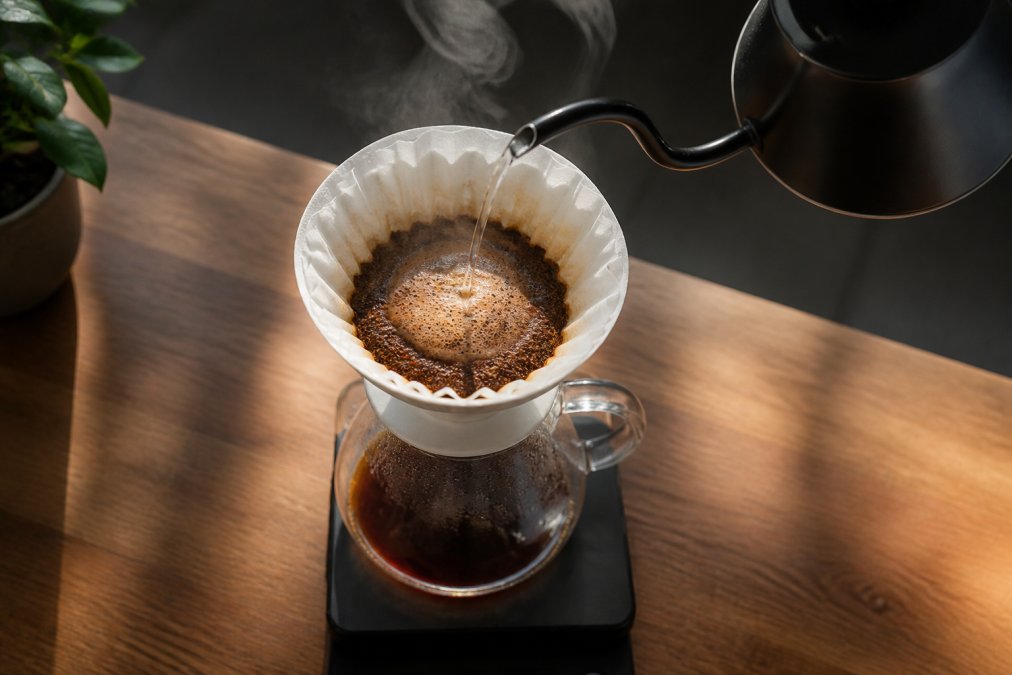
The bloom stage in pour over brewing directly ties to degassing. When you pour a small amount of hot water over fresh grounds and let them sit for 30 to 45 seconds, you release residual CO₂ before the main brew. Beans that are too fresh bloom aggressively; beans that are too old barely bloom at all, a reliable freshness indicator.
According to the Specialty Coffee Association's brewing resources, proper degassing is one of the most overlooked variables in home brewing, yet it directly affects extraction consistency.
Coffee Bean Origin Profiles: How to Pick for Flavor
Origin is one of the fastest ways to dial in the flavor profile you want:
| Origin | Typical Flavor Notes | Acidity | Body |
|---|---|---|---|
| Ethiopia | Blueberry, jasmine, citrus | High | Light |
| Colombia | Caramel, red apple, hazelnut | Medium | Medium |
| Brazil | Chocolate, nuts, low fruit | Low | Full |
| Guatemala | Brown sugar, dark fruit, cocoa | Medium-high | Medium-full |
| Sumatra | Earthy, cedar, dark chocolate | Low | Heavy |
East African origins offer brightness and fruit-forward notes. Brazil and Sumatra provide sweeter, heavier mouthfeel that holds up in milk-based drinks. Knowing your origin preferences makes choosing a blend far less guesswork.
How to Choose a Coffee Grinder That Fits Your Brew Method
A mediocre grinder paired with excellent beans will produce mediocre coffee. The grind is where consistency lives or dies and affects extraction more directly than almost any other variable.
Burr Grinder vs. Blade Grinder: Consistency Is the Difference
A burr grinder crushes coffee between two abrasive surfaces to produce uniform particle sizes. A blade grinder chops beans randomly, producing fine dust and large chunks. That uneven distribution causes channeling in espresso and uneven extraction in pour over, where some particles over-extract (bitter) while others under-extract (sour) in the same brew.
For anyone serious about brewing better coffee at home, a burr grinder is non-negotiable. Flat burr grinders produce more consistent grind distribution. Conical burr grinders are quieter, retain less coffee between uses, and work well across all brew methods.
Matching Grind Size to Your Brewing Method
Grind size controls brew time, which controls extraction:
- Extra coarse: Cold brew (steep time 12-24 hours)
- Coarse: French press (4-minute steep)
- Medium-coarse: Chemex, percolator
- Medium: Drip coffee machines
- Medium-fine: Pour over (Hario V60, Kalita Wave)
- Fine: Espresso (20-30 second extraction)
- Extra fine: Turkish coffee
A common mistake is grinding too fine for drip machines, which slows flow rate, extends brew time, and produces over-extracted, bitter coffee.
Best Coffee to Water Ratio for Every Brew Method
The best coffee to water ratio is the foundation of repeatable, great-tasting coffee. The Specialty Coffee Association's guideline is 1 gram of coffee per 15 to 18 grams of water, though the ideal ratio shifts by brew method and personal preference.
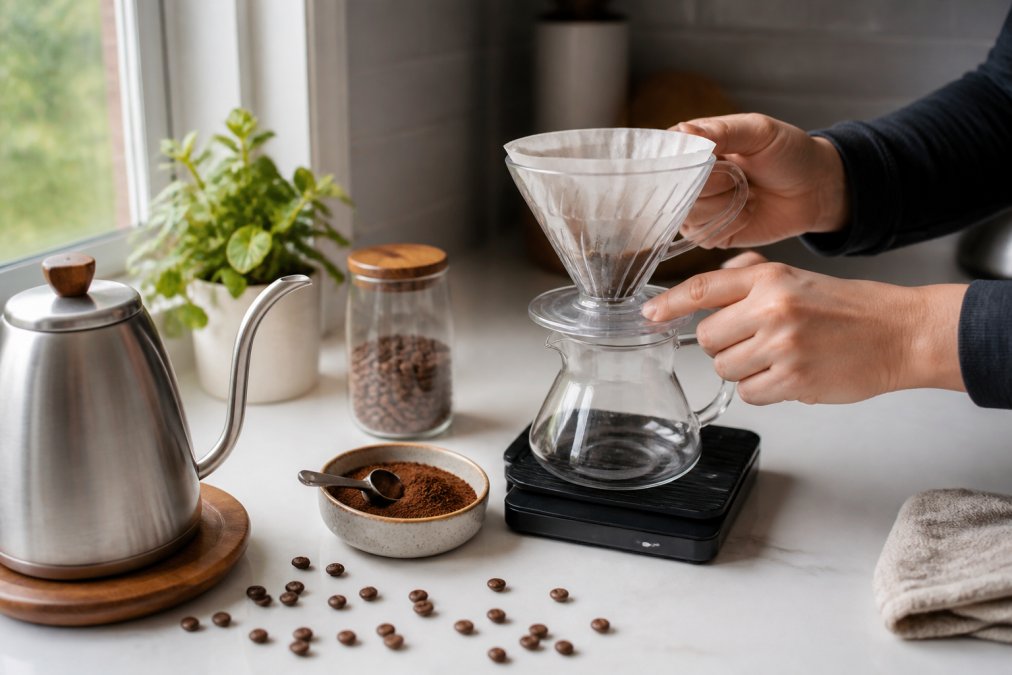
Brewing by weight rather than volume is the single most reliable change most home brewers can make. Volume measurements using scoops vary significantly depending on grind size and packing density. Weight does not lie.
Using a Digital Scale for Repeatable Results
A digital scale removes the biggest source of inconsistency in home brewing:
| Brew Method | Coffee (g) | Water (g) | Ratio |
|---|---|---|---|
| Pour Over | 15 | 250 | 1:16.7 |
| French Press | 30 | 500 | 1:16.7 |
| Drip Coffee | 60 | 1000 | 1:16.7 |
| Espresso (double) | 18 | 36 | 1:2 |
| Cold Brew | 100 | 700 | 1:7 |
| AeroPress | 15 | 200 | 1:13 |
Start at the middle of the range and adjust one variable at a time. If the cup tastes weak, reduce water or increase coffee. If it tastes bitter, go the other direction.
Water Temperature, Quality, and Filtration
Water makes up roughly 98% of your brewed coffee. Its quality is structural, not secondary.
The target water temperature for most brew methods falls between 195°F and 205°F, just off a full boil. Water below 195°F under-extracts, leaving the slurry weak and sour. Water above 205°F over-extracts, pulling bitter compounds too quickly.
According to the SCAA water quality standards for brewing, ideal brewing water has a total dissolved solids content between 75 and 250 parts per million, with a neutral pH around 7. Filtered water, whether through a pitcher filter or inline tap filter, is the practical solution for most home brewers. Distilled water is not recommended: it strips minerals that aid extraction and produces a flat, hollow cup.
Brew Better Coffee at Home: Techniques by Method
Technique is where the variables you have already dialed in, fresh beans, consistent grind, correct ratio, filtered water at the right temperature, either come together or fall apart.
Pour Over: The Bloom, Agitation, and Brew Time
Pour over brewing rewards attention. The process is precise, and results directly reflect every decision:
- Pre-rinse your filter paper with hot water to remove papery taste and preheat the vessel
- Add your ground coffee and level the bed gently
- Start the bloom: pour twice the weight of coffee in water (e.g., 30g water for 15g coffee) and wait 30-45 seconds
- Pour in slow, concentric spirals, keeping the water level consistent
- Total brew time should fall between 2:30 and 3:30 minutes for medium-fine grind
- Agitation (gently swirling mid-brew) promotes even extraction and reduces channeling
If brew time runs long and tastes bitter, coarsen the grind. If it runs short and tastes sour, go finer.
French Press and Immersion Brewing
French press is immersion brewing: grounds steep in water for the full brew time. This produces a heavier body and richer mouthfeel than filter methods, because no filter paper strips natural oils.
Add coarse-ground coffee, pour all your water at once at 200°F, place the lid on without pressing, and steep for 4 minutes. Press slowly and pour immediately. Leaving coffee in contact with grounds after pressing continues extraction and turns the cup bitter.
Using medium-fine grind in a French press is a common mistake. Fine particles pass through the mesh filter and create a gritty, over-extracted cup. Coarse is a requirement for the method.
Drip Coffee: Getting the Most From Your Machine
Most standard drip machines heat water to only 185°F-190°F, below the extraction sweet spot. The result is chronically under-extracted coffee that tastes weak and sour.
Look for machines that are SCAA-certified for home brewing performance, as these reach and hold the correct temperature range. Alternatively, pre-heat the machine by running a water-only cycle before brewing.
Keep your machine clean. Coffee oils build up in the brew basket and carafe over time, turning rancid. A monthly descaling cycle is the minimum maintenance standard.
Troubleshooting Bitter or Sour Coffee
Bitter and sour coffee each have a specific cause. Diagnosing which tells you exactly what to adjust.
Sour coffee is under-extraction. Causes: grind too coarse, water temperature too low, brew time too short, or coffee-to-water ratio too low.
Bitter coffee is over-extraction. Causes: grind too fine, water temperature too high, brew time too long, or coffee-to-water ratio too high.
A well-extracted cup has a clean finish, balanced acidity, and lingering sweetness. Grind size is almost always the first variable to adjust, it has the most immediate effect on extraction.
Sensory Training and Sustainability: Two Habits That Elevate Every Cup
Sensory training is deliberately tasting and describing your coffee to build a flavor vocabulary. Without it, you cannot communicate what is wrong with a cup. Start by tasting your coffee before adding anything. Try to identify fruit, chocolate, nuts, acidity, and body.
The World Coffee Research sensory lexicon lists 110 flavor attributes with physical reference standards and trains your palate faster than any other method.
Sustainability in home brewing is practical. Use spent grounds as garden fertilizer, choose reusable metal filters instead of paper, buy whole beans in quantities you will use within three to four weeks, and store beans in an airtight container away from light and heat, not in the freezer.
Single-origin beans from farms with transparent sourcing tend to be fresher and more interesting to taste. When you know a coffee's origin, you taste with more attention, sharpening your palate faster than formal training.
Brewing great coffee at home is less about expensive equipment and more about controlling the variables that matter most: bean freshness, grind consistency, ratio, water quality, and temperature. If any one is off, the others cannot compensate. At Coffee Depot, every blend is roasted to order and shipped directly to you, so the freshness question is answered before you pick up a grinder. With expertly curated blends designed for the true enthusiast, and $1 from every item sold going to charity, each cup you brew carries more meaning. Start with fresh beans from Coffee Depot and put these techniques to work.
Frequently Asked Questions
What is the ideal coffee-to-water ratio for a perfect cup?
The most widely recommended starting point is 1:15 to 1:17 by weight, roughly 1 gram of coffee for every 15 to 17 grams of water. For a standard 12-ounce mug, that works out to about 20 to 22 grams of coffee. Use a digital scale rather than scoops for consistency. Once you have a baseline, adjust slightly toward 1:15 for a fuller body or 1:17 for a lighter, brighter cup depending on your taste and brew method.
How does grind size impact the flavor of home-brewed coffee?
Grind size controls how quickly water extracts compounds from the coffee. A grind that is too fine increases contact time and pulls bitter, harsh flavors, over-extraction. Too coarse and water passes through without drawing out enough sweetness or acidity, under-extraction, which tastes sour or thin. Each brew method needs a specific range: coarse for French press, medium for drip coffee, and fine for espresso. A burr grinder gives you consistent particle size, which is the single biggest factor in repeatable, balanced extraction.
Does the type of water affect coffee brewing quality?
Yes, significantly. Coffee is roughly 98% water, so mineral content matters. Water that is too soft lacks the ions needed to bond with flavor compounds; water that is too hard leaves chalky, flat-tasting brews. Filtered tap water with moderate total dissolved solids, generally between 75 and 150 parts per million, produces the cleanest, most balanced extraction. Avoid distilled water entirely, and skip unfiltered tap water if your supply is heavily chlorinated, since chlorine suppresses delicate tasting notes.
How can I make my coffee taste better at home without buying expensive equipment?
Three low-cost changes make the biggest difference. First, buy freshly roasted beans and use them within three to four weeks of the roast date, stale beans are the most common reason home coffee tastes flat. Second, store beans in an airtight container away from light and heat rather than the freezer. Third, use a kitchen scale instead of a scoop to measure your coffee-to-water ratio consistently. A basic digital scale costs under $15 and eliminates the guesswork that causes most bitter or sour cups.
This article was written using GrandRanker