

Where to Buy Fresh Roasted Coffee: A 2026 Buyer's Guide
Table of Contents
- Why Fresh Roasted Coffee Tastes Fundamentally Different
- Coffee Roast Dates Explained: What the Label Is Really Telling You
- Single-Origin vs. Blended Fresh Roasted Coffee
- Best Coffee Subscription Services for Roast-to-Order Freshness
- How to Store Coffee Beans for Freshness After Delivery
- A Sensory Evaluation Guide: How to Cup Your Coffee at Home
- Whole Bean vs. Pre-Ground: What to Order for Peak Flavor
- Conclusion
Last Updated: August 8, 2026
Why Fresh Roasted Coffee Tastes Fundamentally Different
Fresh roasted coffee is not just marketing, it describes a genuinely different product from grocery store shelves. Coffee Depot built its model on one conviction: coffee roasted to order and shipped directly to you tastes categorically better than anything roasted weeks or months in advance.
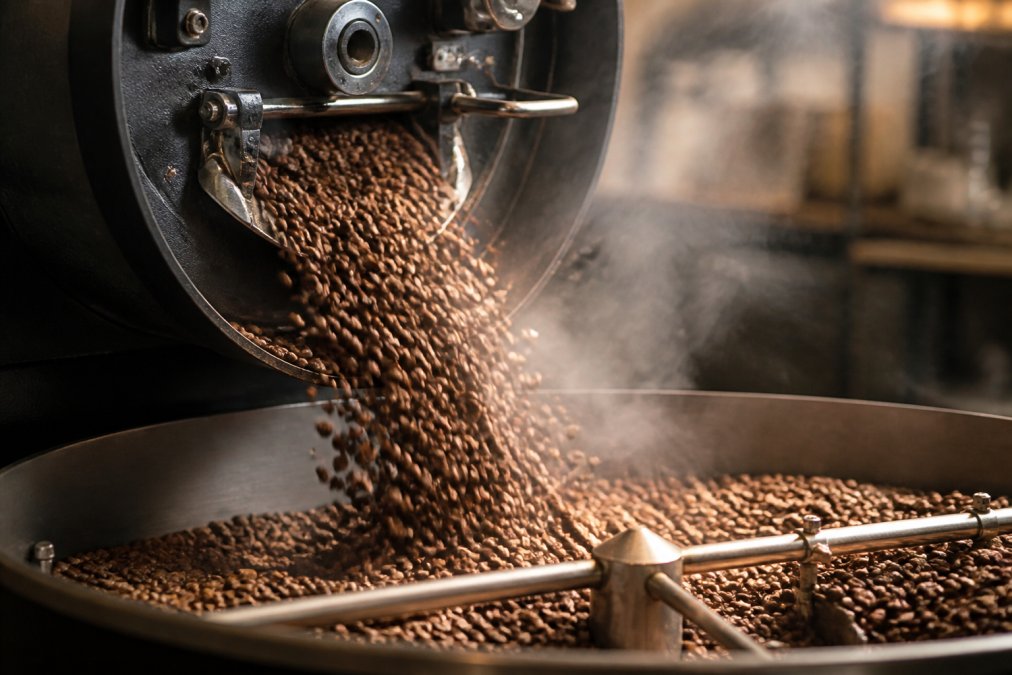
When green arabica beans hit heat, hundreds of volatile aromatic compounds develop, fruity esters, floral aldehydes, caramel-like furans that give specialty coffee its complexity. Those compounds begin dissipating the moment roasting ends. A bag that spent three weeks in a distribution center and two more on a retail shelf has already shed a significant portion of what made it interesting. Freshness means capturing coffee at its peak, typically between 5 and 21 days after roasting, depending on roast profile and brewing method.
The Science of Degassing and Why It Matters
Degassing is the process by which roasted coffee releases carbon dioxide (CO₂) trapped inside the bean during roasting. It is one of the least-discussed but most important factors in coffee quality.
Immediately after roasting, beans release CO₂ aggressively. Brew them too soon and that gas interferes with extraction, your grounds repel water, espresso shots channel unevenly, and pour-overs produce weak, underdeveloped cups. Most roasters recommend waiting 24 to 72 hours after roasting for espresso, and 7 to 14 days for filter methods, before brewing.
The one-way valve on quality coffee bags exists precisely for this reason: it lets CO₂ out without letting oxygen in. A bag without that valve either vents CO₂ into the bag or the coffee was roasted so long ago that degassing is already complete, neither is a good sign.
How to Identify Fresh Coffee Beans Before You Buy
The single most reliable indicator of fresh coffee is a printed roast date on the bag, not a "best by" date, but a clear, prominent roast date.
Other signs worth checking:
- Whole bean over pre-ground: Ground coffee degasses and oxidizes far faster.
- One-way valve present: Signals the roaster understands degassing and packed properly.
- Small-batch or roast-to-order language: Roasters committing to small-batch production have less inventory sitting between roast and shipment.
- Opaque, resealable packaging: Light and air are enemies of fresh coffee. Clear bags are a red flag.
"Specialty coffee" on a label means nothing without a roast date. The date is the only objective data point you can verify before buying.
Coffee Roast Dates Explained: What the Label Is Really Telling You
A roast date tells you when beans were transformed from green to roasted, and from that moment, a clock starts ticking on peak flavor. This is different from a best-before date, which many mass-market brands print 12 to 18 months out, telling you almost nothing about actual roast timing.
The general freshness windows most specialty roasters follow:
| Roast Profile | Earliest Brew Date | Peak Freshness Window | Acceptable Shelf Life (sealed) |
|---|---|---|---|
| Light roast | 7-10 days post-roast | 10-21 days | Up to 4 weeks |
| Medium roast | 3-7 days post-roast | 7-18 days | Up to 4 weeks |
| Dark roast | 1-3 days post-roast | 5-14 days | Up to 3 weeks |
Dark roasts degas faster because the cellular structure is more porous after extended heat exposure. They hit peak flavor sooner but fade sooner. Light roasts are denser and degas more slowly, extending complexity.

When shopping online, look for roasters who roast to order, meaning your bag is roasted after you place your order, not pulled from existing inventory. This is the only model that consistently guarantees a roast date within days of delivery.
Specialty Coffee Association's guide to coffee freshness and packaging standards
Single-Origin vs. Blended Fresh Roasted Coffee
Do you want to taste a place, or do you want consistency?
Single-origin coffee comes from one farm, cooperative, or defined growing region. Coffee Depot's Peru medium roast, sourced from Cooperativa Agrícola de Servicios Norandino, tastes of salted caramel, silky sweetness, and citrus that reflect the specific altitude, soil, and processing method of that region. Single-origin coffees reward attention and exploration.
Blended coffee combines beans from multiple origins to achieve a consistent, balanced flavor profile across different brewing methods. Coffee Depot's House Blend draws from Central and South American origins to produce a smooth, clean, medium roast that performs reliably whether you're using a drip machine, French press, or pour-over. Blends are the right choice when consistency matters more than exploration.

Neither is superior, the right choice depends entirely on how you drink coffee.
Matching Roast Profiles to Your Brewing Method
Roast profile and brewing method are not independent variables. The wrong pairing undersells both the beans and your equipment.
Light roasts shine in pour-over, AeroPress, and siphon brewing, which allow full extraction at lower temperatures (around 200°F). Their higher acidity and delicate floral notes benefit from precise temperature control and longer contact time.
Medium roasts are the most versatile. Coffee Depot's House Blend and Breakfast Blend work well across drip, French press, pour-over, and standard espresso setups. If you're brewing on a home machine without temperature control, medium roast is your safest choice.
Dark roasts are purpose-built for espresso and cold brew. The lower acidity and heavier body stand up to milk, pressure extraction, and long cold-brew steeps. Coffee Depot's 6 Bean Blend is crafted specifically for espresso lovers who want depth and intensity.
Best Coffee Subscription Services for Roast-to-Order Freshness
The best coffee subscription services share one non-negotiable characteristic: they roast after you order, not before. Any service pulling from pre-roasted inventory is delivering coffee that may be days or weeks old before it leaves the warehouse.
When evaluating subscription options, ask:
- Is the coffee roasted to order, or from existing stock?
- What is the typical time between roast and shipment?
- Can you choose your roast profile and grind size?
- Is there a commitment requirement, or can you order on demand?
Coffee Depot operates on a roast-to-order model: your coffee is not roasted until you place your order, then shipped directly to you. There is no warehouse inventory aging between roast and delivery.
Local Roastery vs. National Shipping: Which Gets You Fresher Beans?
Local does not automatically win. A local roastery that roasts on Tuesdays and sells through a café counter may have beans sitting in an open hopper for days before you buy them. A national roast-to-order service that ships within 24 hours of roasting can deliver fresher beans by the time they reach your door.
What determines freshness in transit:
- Roast-to-ship time: The gap between when beans finish roasting and when they leave the facility. Shorter is better.
- Packaging quality: Nitrogen-flushed, valve-sealed bags protect beans far better than paper bags with twist ties.
- Shipping speed: Two-day shipping on a roast-to-order bag often outperforms same-week local purchase from a roastery with slow turnover.
Local roasteries have real advantages: you can ask questions and sometimes buy beans the same day they're roasted. But for consistent, verified freshness delivered to your door, a transparent roast-to-order service with proper packaging competes directly with the best local options.
USDA Agricultural Marketing Service guidelines on food labeling and freshness dating
How to Store Coffee Beans for Freshness After Delivery
Poor storage can undo the freshness advantage of a roast-to-order purchase within days. The four enemies of fresh coffee are oxygen, moisture, light, and heat.
- Oxygen: Keep beans in an airtight container. Once you open the original bag, transfer to a container with a tight seal or use the bag's reseal mechanism consistently.
- Moisture: Never store coffee near a sink, dishwasher, or any source of steam.
- Light: Store in an opaque container or dark cabinet. Clear glass canisters on a sunny counter accelerate staling.
- Heat: Room temperature storage (away from the stove) is ideal for beans you'll use within two weeks. Do not refrigerate, temperature fluctuation and humidity cause condensation on the beans.
The most practical approach: buy smaller quantities more frequently. A 12-ounce bag used within two weeks at room temperature in a sealed container will always outperform a large bag that sits open for a month.
A Sensory Evaluation Guide: How to Cup Your Coffee at Home
Cupping is the standardized method specialty coffee professionals use to evaluate flavor, aroma, acidity, body, and finish. You don't need professional equipment to apply the same principles at home.
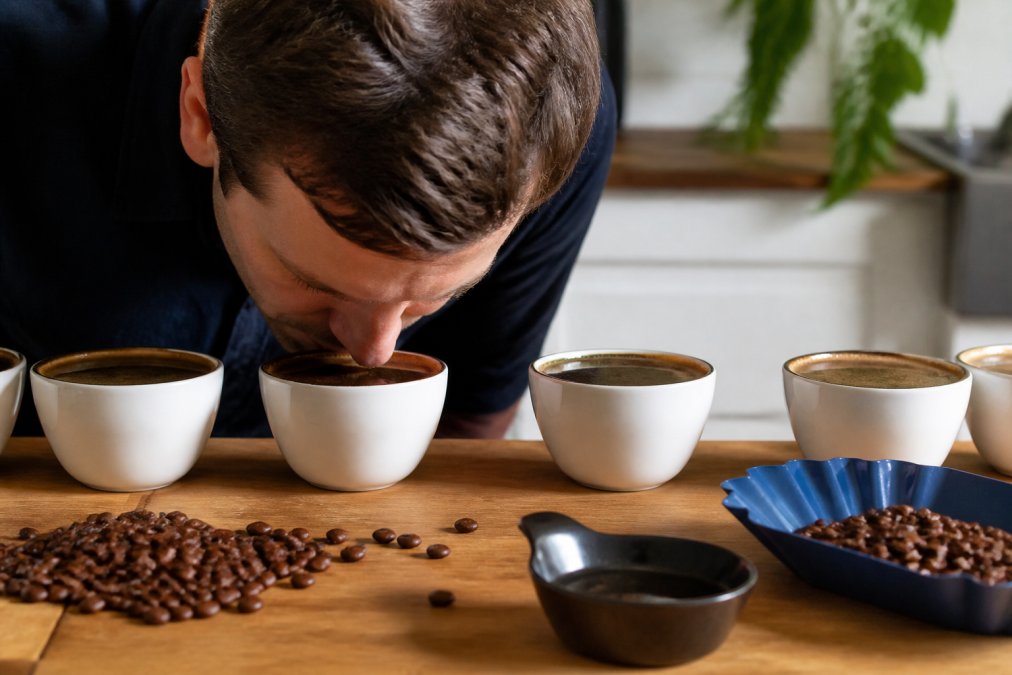
A simplified home cupping protocol:
- Grind coarsely, about the consistency of raw sugar. Use 10 grams of coffee per 6 ounces of water.
- Smell the dry grounds, note whether you detect fruit, floral, nut, chocolate, or earthy tones.
- Add water just off the boil (around 200°F) and let steep for four minutes without stirring.
- Break the crust, gently push the floating grounds aside with a spoon and inhale deeply. This is often the most revealing moment.
- Skim the grounds and let the coffee cool slightly before tasting.
- Slurp, drawing the coffee across your palate with some air to aerate and distribute it across your taste receptors.
What to evaluate:
| Attribute | What You're Assessing | Descriptors to Use |
|---|---|---|
| Aroma | Fragrance before and after brewing | Floral, fruity, nutty, smoky, earthy |
| Acidity | Brightness or tartness on the palate | Crisp, citrusy, winey, flat |
| Body | Weight and texture in the mouth | Light, silky, full, syrupy |
| Flavor | Overall taste impression | Caramel, chocolate, berry, vanilla |
| Finish | Aftertaste length and quality | Clean, lingering, bitter, sweet |
Cupping the same coffee on day 7 and day 21 post-roast reveals how flavor evolves. This exercise trains you to identify the difference between a genuinely fresh roast and one that has faded.
Specialty Coffee Association's official cupping protocols and scoring sheets
Whole Bean vs. Pre-Ground: What to Order for Peak Flavor
Whole bean coffee is the right choice for almost every home brewer. Pre-ground coffee has surface area many times greater than whole beans, which accelerates oxidation and off-gassing dramatically. A bag of pre-ground loses a measurable portion of its volatile aromatics within 15 minutes of grinding.
The counterargument is convenience. For coffee drinkers using a drip machine with a built-in grinder, or those who will not invest in a burr grinder, pre-ground from a roast-to-order source is still meaningfully better than pre-ground grocery store coffee. But if you want to experience what fresh roasted coffee actually tastes like, whole bean is the only path. A mid-range burr grinder and freshly ground beans transform the cup.
Grind size by brewing method:
| Brewing Method | Grind Size | Consistency Target |
|---|---|---|
| Espresso | Extra fine | Uniform, flour-like |
| AeroPress | Medium-fine | Slightly coarser than espresso |
| Pour-over | Medium | Granulated sugar texture |
| Drip machine | Medium | Similar to pour-over |
| French press | Coarse | Sea salt texture |
| Cold brew | Extra coarse | Rough, chunky |
Grind only what you'll use in a single brew session. Pre-grinding a week's worth of beans defeats the purpose of buying whole bean.
National Coffee Association's guide to brewing methods and grind standards
Sourcing genuinely fresh roasted coffee comes down to one question: was this bean roasted for you, or for a shelf? The difference in the cup is not subtle. Coffee Depot's roast-to-order model, where every bag is roasted after your order is placed and shipped directly to you, is built around that distinction. Whether you're drawn to the smooth consistency of the House Blend, the bold espresso character of the 6 Bean Blend, or the single-origin complexity of the Peru, each bag arrives at the start of its peak window, not the end. And with $1 from every item donated to charity, every order does something beyond the cup. Find your roast at Coffee Depot and taste what fresh actually means.

Frequently Asked Questions
What is the freshest coffee you can buy?
The freshest coffee comes from roasters who roast to order, meaning your beans are roasted only after you place your purchase, then shipped immediately. Look for a printed roast date on the bag, beans roasted within the past 7 to 21 days are at peak freshness. Roast-to-order specialty coffee, like the blends offered at Coffee Depot, skips warehouse storage entirely, so what arrives at your door was roasted specifically for your order.
Where can I buy fresh roasted coffee online?
The best place to buy fresh roasted coffee online is directly from a roastery that roasts to order and ships same-day or next-day. Coffee Depot roasts every order fresh before shipping and offers expertly curated blends and single-origin options starting at $18.99. Avoid marketplace resellers and grocery store brands, which rarely display roast dates and often sit in distribution warehouses for weeks before reaching you.
How can you tell if coffee beans are fresh?
Check the roast date printed on the bag, a best-by or expiration date alone tells you nothing useful. Fresh beans should feel slightly oily or dry depending on roast level, never dusty or crumbly. When you open the bag, a strong, complex aroma is a reliable sign of freshness. Stale beans smell flat or cardboard-like. You can also do a bloom test when brewing: fresh grounds will puff up and release CO2 within seconds of hot water contact.
How long does fresh roasted coffee stay fresh?
Whole bean coffee is at its best between 5 and 21 days after the roast date, with the sweet spot typically around days 7 to 14 for most brewing methods. After 30 days, flavor compounds degrade noticeably. Pre-ground coffee loses peak freshness within 30 minutes of grinding. Storing beans in an airtight, opaque container away from heat and light extends shelf life, but no storage method fully replaces buying fresh roasted coffee regularly.
Do I have to commit to a subscription to get fresh roasted coffee?
No. While subscriptions offer the convenience of automatic reorders, many roast-to-order services, including Coffee Depot, allow one-time purchases with no lock-in. This suits remote workers or occasional buyers who prefer ordering on their own schedule. If you find a blend you love, a flexible subscription can automate restocking without a long-term commitment. The key advantage of any subscription model is that each shipment is still roasted fresh at the time of your order.
Is fresh roasted coffee actually better than grocery store coffee?
Yes, for most coffee drinkers the difference is clear. Grocery store coffee is typically roasted weeks or months before purchase and stored without a visible roast date. Fresh roasted specialty coffee retains volatile aromatic compounds that give it complexity, bright acidity, distinct body, and layered flavor notes like caramel or citrus. These qualities fade quickly after roasting, which is why the time between roast and brew matters more than almost any other variable in the cup.
This article was written using GrandRanker