

Roast to Order vs Warehouse Coffee Beans
Table of Contents
- Roast to Order vs Warehouse Coffee Beans: The Core Difference
- How Degassing and Oxidation Impact Your Cup
- Coffee Bean Shelf Life and Freshness Windows
- How to Tell If Coffee Beans Are Fresh
- Cost-Benefit Analysis: What You Actually Pay
- Roast to Order vs Warehouse: Pros and Cons
- Which Option Matches Your Brewing Method
- Conclusion
Last Updated: August 22, 2026
Roast to Order vs Warehouse Coffee Beans: The Core Difference
When you order coffee online, you're choosing between roast-to-order (roasted after your order, shipped within days) and warehouse coffee (sitting in inventory for weeks or months before shipment). This timing difference fundamentally changes what reaches your cup. The moment beans finish roasting, they begin losing volatile aromatic compounds and flavor complexity. A bean roasted 5 days before arrival tastes dramatically different from one that's been warehoused for 60 days.
Roast-to-order services prioritize peak flavor; warehouse models prioritize inventory efficiency and lower operational costs. Both are valid approaches, the question is which aligns with what you want from your morning cup.
How Degassing and Oxidation Impact Your Cup
Roasted coffee beans release carbon dioxide for 24-48 hours after roasting, a process called degassing (peer-reviewed research). During roasting, heat breaks down cellular structures and releases CO2. If you brew beans immediately after roasting, excess CO2 can interfere with water's ability to extract flavor evenly, this is why pour-over brewing includes a "bloom" phase to release trapped CO2 before brewing.
Warehouse beans have already completed degassing by the time they reach you. The advantage: they're more stable and predictable to brew. The disadvantage: they've already lost volatile aromatic compounds that give fresh coffee its complexity and brightness.
Oxidation is the slower, longer-term process. Once CO2 escapes, oxygen breaks down the lipids and organic compounds that create flavor and aroma. This happens continuously and irreversibly. Roast-to-order services minimize oxidation by getting beans to you while they're still chemically "young." Warehouse models accept oxidation as a trade-off for inventory convenience.
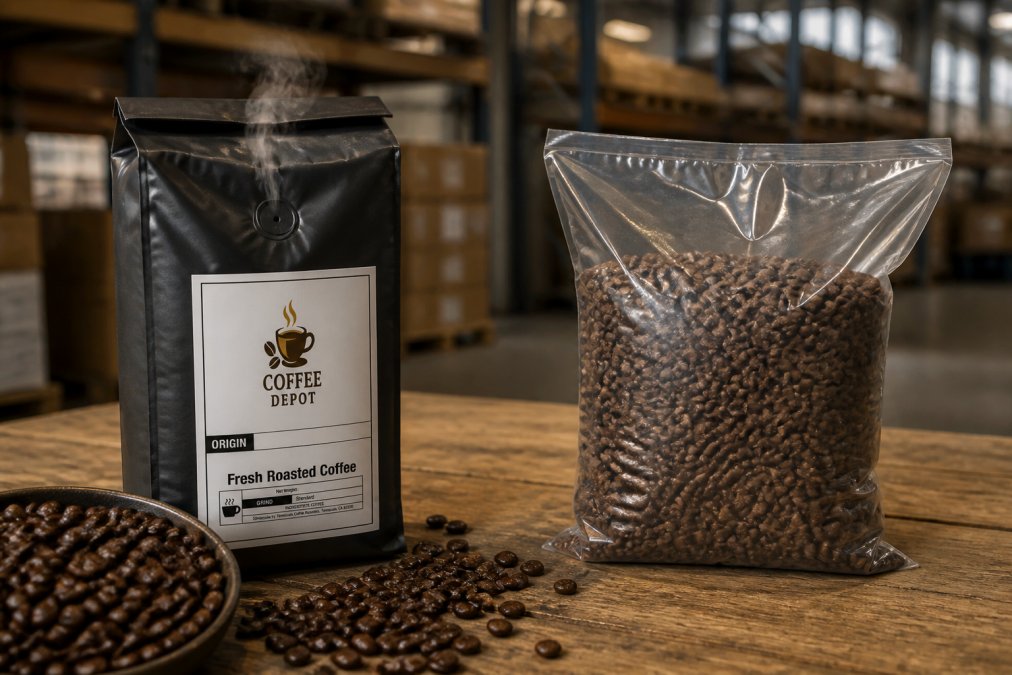
Fresh beans deliver brighter acidity, more complex tasting notes, and fuller aroma. Older beans taste flat, muted, and often develop woody or stale notes. If you've wondered why coffee from a local roaster tastes better than grocery store coffee, oxidation and degassing are largely responsible.
Coffee Bean Shelf Life and Freshness Windows
Whole beans stored in an airtight container at room temperature remain drinkable for 3-4 weeks. Ground coffee has a much shorter window: 1-2 weeks, since grinding dramatically increases surface area exposed to oxygen.
Peak flavor occurs between 5-14 days after roasting, when CO2 has mostly escaped (making brewing more predictable) but oxidation hasn't yet degraded aromatic complexity. This window is why roast-to-order services exist. Warehouse models operate on a different timeline: beans might be roasted, packaged, shipped to a distributor, held in inventory, repackaged, and shipped to you, a process often taking 3-8 weeks. By arrival, they're past peak freshness but still technically "fresh" if stored properly.
Storage conditions matter enormously. Heat, light, air, and humidity all accelerate oxidation. Warehouse beans in climate-controlled facilities degrade more slowly than those exposed to temperature fluctuations or sunlight. For home storage, use an airtight container kept away from heat and light. Freezing can extend shelf life if beans are properly sealed, though temperature fluctuations can damage bean structure.
If you care about flavor, bean age matters more than almost any other variable except brewing technique. Roast-to-order services guarantee younger beans; warehouse models guarantee convenience and lower cost, with the trade-off of drinking coffee past its flavor peak.
How to Tell If Coffee Beans Are Fresh
The most reliable indicator is the roast date on the bag. If there's no roast date printed, that's a red flag. A reputable roaster prints the roast date prominently because it's verifiable proof of freshness. If you see only a "best by" date or no date at all, you're likely looking at warehouse coffee that's been sitting for weeks.
Visual inspection provides secondary clues. Fresh beans have a visible sheen on the surface, especially with darker roasts. This reflects the natural oils of the bean becoming visible as cellular structures break down during roasting. Warehouse beans often look dull or matte because oxidation has degraded these oils.
Aroma is the most immediate sensory test. Fresh beans smell vibrant and complex when you open the bag. Warehouse beans smell muted or flat. If your beans smell faintly stale, woody, or musty, oxidation has progressed significantly.
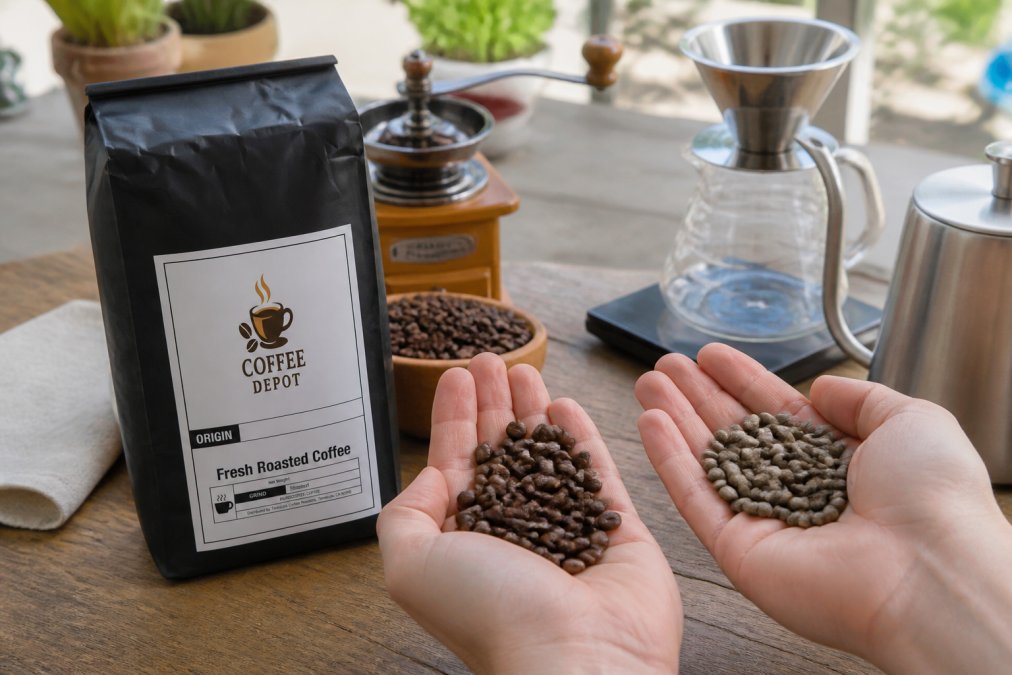
When you grind fresh beans, aroma releases immediately and intensely. Stale coffee produces little aroma when ground. If brewed coffee tastes flat, thin, or woody, lacking the complexity the roaster intended, age is likely the culprit.
The most practical approach: buy from roasters who print roast dates, order roast-to-order when possible, and use beans within 2-3 weeks of roasting for optimal flavor. Coffee Depot prints roast dates on every bag and ships within days of roasting.
Cost-Benefit Analysis: What You Actually Pay
Roast-to-order coffee typically costs more upfront than warehouse alternatives. Coffee Depot's blends start at $18.99 per bag, which is higher than commodity grocery store coffee but comparable to other specialty roasters. A bag yields roughly 30-40 cups, depending on brewing method and strength, roughly 47-63 cents per cup. A specialty coffee shop charges $5-7 per cup. Grocery store bags might cost $8-12 (25-40 cents per cup), but the flavor difference is substantial. Roast-to-order sits in the middle: higher than budget options but dramatically cheaper than daily café visits.
Warehouse coffee costs less because retailers benefit from scale, lower inventory costs, and longer stock holding. If your primary concern is cost per cup, warehouse coffee wins. If your primary concern is flavor and freshness, roast-to-order wins, and the price premium is modest compared to café-equivalent quality.
Subscription models change the equation. Coffee Depot allows one-time purchases without subscription obligations, so you're not locked into recurring charges. Shipping costs are the hidden variable: roast-to-order services ship more frequently, increasing per-order shipping. Warehouse models benefit from bulk shipping and lower per-unit logistics costs. Single-bag orders might see 20-30% shipping additions; multiple bags or subscriptions reduce per-unit shipping cost significantly.
The real comparison: roast-to-order is worth the premium if you're a regular coffee drinker who values flavor. If you drink casually or primarily want caffeine delivery, warehouse coffee offers better value. If you're comparing roast-to-order to daily café visits, roast-to-order is dramatically cheaper while delivering comparable quality.
Roast to Order vs Warehouse: Pros and Cons
Roast to Order: Pros
Peak freshness is the defining advantage. Beans arrive at their flavor peak, delivering complexity and aroma that warehouse beans can't match, especially in lighter roasts where subtle tasting notes are pronounced.
Control and transparency follow. You know exactly when beans were roasted because the roaster prints the date. Small-batch roasting allows quality control and customization. If you want to explore different roasts, single-origin beans, or roast levels, roast-to-order services typically offer more variety.
Roast to Order: Cons
Higher cost is the primary drawback due to operational complexity, smaller batch sizes, and frequent shipping. Longer wait times for delivery are necessary for roasting. If you're out of coffee and need it today, roast-to-order won't help. Dependency on the roaster's schedule can cause delays if stock is unavailable.
Warehouse Coffee: Pros
Lower cost is the primary advantage through bulk purchasing and mass production. Immediate availability means warehouse stock ships quickly. Beans have completed degassing and oxidation has stabilized, making brewing behavior more consistent. Convenience for casual consumption is ideal if you're not particular about flavor nuances.
Warehouse Coffee: Cons
Compromised freshness is the core trade-off. By arrival, beans are past their flavor peak and oxidation has degraded aromatic compounds. Less transparency means roast dates are often obscured or absent. Mass production optimizes for volume and consistency, not individual batch quality. Limited variety means the same beans stock month after month. Environmental impact is higher due to more packaging, longer storage, and frequent label reprinting.
Which Option Matches Your Brewing Method
Your brewing method determines sensitivity to bean age and freshness.
Pour-over and manual brewing methods (Chemex, V60, Melitta) are most sensitive to bean age. These methods require precise water temperature, timing, and grind size. Fresh beans with active CO2 require slightly different technique than aged beans. The bloom phase is essential with fresh beans to release trapped CO2. Pour-over methods highlight subtle flavor differences, so oxidized and flat beans emphasize that flatness. Fresh beans shine because the method extracts and showcases the bean's complexity.
Espresso is moderately sensitive. Fresh beans with active CO2 can cause channeling, degrading shot quality. Aged beans are more stable and predictable. The ideal is beans 7-14 days post-roast: CO2 has mostly escaped, but aromatic compounds remain intact. Roast-to-order services hit this window perfectly.
French press and immersion brewing are least sensitive to bean age. Longer steep times and coarser grinds are more forgiving of oxidation and CO2 variations. A 60-day-old bean produces acceptable French press coffee, though flatter and less complex than fresh beans.
Automatic drip machines are moderately forgiving but benefit from fresher beans. Older beans work fine but produce more flavor flatness compared to fresh beans.
Single-serve capsules are least sensitive because brewing parameters are fixed. However, fresh beans still produce noticeably better flavor. Coffee Depot offers single-serve capsules roasted fresh, delivering superior taste compared to warehouse capsules.
Conclusion
The choice between roast to order vs warehouse coffee beans depends on what you value most: freshness and flavor, or convenience and cost. Roast-to-order delivers beans at their peak, with the complexity and aroma that make specialty coffee worth exploring. Warehouse models prioritize efficiency and lower prices, accepting oxidation and age as unavoidable trade-offs.
If you're serious about your daily brew, roast-to-order is worth the investment. The flavor difference is immediate and noticeable, especially in lighter roasts and with pour-over and espresso methods. Research on coffee freshness and sensory perception confirms that beans roasted within the previous 2-3 weeks deliver measurably superior flavor profiles compared to beans aged beyond 4 weeks.
For remote workers and home coffee enthusiasts who want to elevate their daily experience, Coffee Depot's roast-to-order model ensures you're getting beans roasted after you order, shipped directly to your door within days. Our expertly curated blends, including the House Blend, Breakfast Blend, and Cowboy Blend, are all available at $18.99 per bag, with no subscription requirement. Every purchase also donates $1 to charity, so your freshness commitment supports your community.


The investment in fresher beans pays dividends in every cup. Start with Coffee Depot's House Blend or Breakfast Blend to experience the difference that roast-to-order freshness makes.
Frequently Asked Questions
Q: How long do roast to order coffee beans stay fresh after roasting?
A: Roast to order beans reach peak flavor 5-7 days after roasting, once degassing completes. They remain fresh for 2-4 weeks when stored in an airtight container away from heat and light. Warehouse beans, by contrast, begin oxidizing immediately and lose complexity within 2-3 weeks of roasting. For maximum quality, brew roast to order coffee within 14 days of the roast date.
Q: What's the flavor difference between fresh-roasted and warehouse coffee?
A: Fresh-roasted coffee delivers vibrant acidity, complex tasting notes, and full aroma, the sensory experience roasters intended. Warehouse coffee loses these qualities through oxidation. Acidity becomes muted or harsh, body flattens, and subtle notes fade into a one-dimensional taste. A warehouse bean stored 8 weeks tastes noticeably stale compared to a roast-to-order bean shipped within days. Specialty coffee enthusiasts detect this instantly; casual drinkers may not notice until they try a truly fresh roast.
Q: Is roast to order coffee worth the extra cost compared to warehouse beans?
A: That depends on your priorities and brewing method. Roast-to-order typically costs $18-20 per bag and includes shipping; warehouse beans from grocery stores cost $8-12 but taste flat by comparison. If you use a pour-over, French press, or espresso machine, you'll taste the difference immediately, making roast to order worth it. If you brew automatic drip coffee or use heavily filtered methods, the gap narrows. Remote workers and coffee enthusiasts justify the premium for flavor and freshness; convenience-focused drinkers may prefer the lower upfront cost of warehouse stock.
Q: How can I tell if coffee beans are actually fresh when they arrive?
A: Check the roast date on the bag first, it should be within 2-7 days of delivery. Fresh beans have a rich, oily sheen and vibrant color; stale beans look dull and dry. Smell the beans: fresh roasts emit a strong, pleasant aroma; warehouse beans smell flat or musty. Finally, brew a small cup: fresh beans bloom visibly in hot water, producing a full, aromatic cup. Stale beans produce weak bloom and thin, bitter taste.
Ready to experience peak freshness? Order your first bag of roast-to-order coffee from Coffee Depot today. Every bean is roasted after you order and shipped directly to you, no warehouse sitting, no compromise on flavor. Plus, $1 from every purchase supports our community partners. Search Coffee Depot roast-to-order coffee to explore our full selection of expertly curated blends.
This article was written using GrandRanker