

How to Clean Your Coffee Grinder Properly
Table of Contents
- Why Cleaning Your Coffee Grinder Matters for Freshness
- Best Tools for Cleaning Coffee Grinders
- How to Clean a Burr Grinder Properly, Step by Step
- How to Clean a Blade Grinder Properly
- Coffee Grinder Cleaning Tablets: What They Do and When to Use Them
- How Often to Clean Coffee Grinder Parts and Why
- Common Mistakes That Damage Grinders (Including the Rice Myth)
- Seasoning Burrs and Managing Static After Cleaning
- Frequently Asked Questions
Last Updated: September 12, 2026
Why Cleaning Your Coffee Grinder Matters for Freshness
Coffee oils go rancid fast, and your grinder is where they collect, which is why knowing how to clean your coffee grinder properly matters so much. Learning how to clean your coffee grinder properly is the single most overlooked step in brewing better coffee at home. Every batch of beans leaves behind a film of oil on the burrs, the chute, and the hopper walls. That film oxidizes within days, and the next grind picks up those stale, bitter compounds (PubMed).
At Coffee Depot, we roast to order precisely so beans arrive fresh. A dirty grinder undoes that work in one push of the button.
The stakes are higher than most people realize. Rancid residue coats the cutting surfaces, which changes how beans fracture and throws off grind consistency. You taste it as a flat, muddy cup even when the beans themselves are excellent.
Best Tools for Cleaning Coffee Grinders
The right cleaning kit costs less than a bag of specialty beans:
- Stiff-bristle brush for sweeping burrs and the chute
- Microfiber cloth for wiping oils off hopper walls
- Small vacuum with a crevice attachment for loose grounds
- Food-safe cleaning tablets for deep degreasing
- Compressed air (used carefully, see below)
Brushes, Cloths, and Vacuums
A dedicated grinder brush reaches into the chute and around the burr carrier where cloths can't. Keep it dry and use it only for coffee. Vacuuming removes the fine dust that brushing kicks loose, and it's the safest way to clear the grind chamber without disassembly.
When Compressed Air Helps and When It Hurts
Compressed air clears loose grounds from tight corners, but a hard blast can push fine dust into the motor housing and bearings. On direct-drive grinders, that dust accelerates wear. Use short, low-pressure bursts aimed away from the motor vents, or skip it entirely and vacuum instead.
How to Clean a Burr Grinder Properly, Step by Step
Burr grinders need periodic full disassembly, not just a surface brush. Here's the sequence that keeps precision parts aligned.
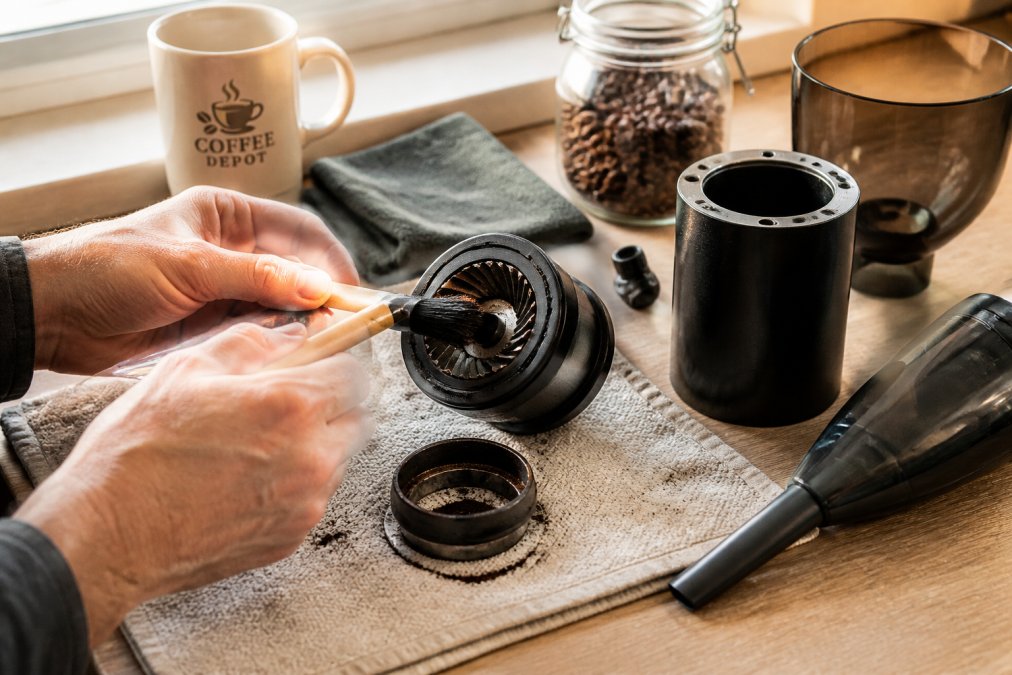
Disassembly and Burr Removal
- Unplug the grinder and empty the hopper completely.
- Remove the hopper and set it aside for washing.
- Twist the burr carrier counterclockwise to release the upper burr.
- Lift out the upper burr and brush both burr faces.
- Vacuum the grind chamber and chute.
- Reassemble and recalibrate your grind setting.
Flat Burrs vs. Conical Burrs: Different Cleaning Protocols
Flat burrs sit horizontally and trap grounds in the space between the discs, so they need more frequent brushing and a careful vacuum of the chute. Conical burrs are vertical, which lets most grounds fall through, but the inner cone collects oil that brushing alone won't remove. Conical sets benefit from cleaning tablets more often.
How to Clean a Blade Grinder Properly
Blade grinders are simpler: wipe, don't soak. Unplug the unit, then wipe the blade and bowl with a slightly damp microfiber cloth. Never run the motor while cleaning, and never submerge the base. For stubborn oil, grind a small amount of dry, uncooked white rice, then discard it and wipe clean. Rice is safe here because blade grinders have no precision burrs to damage.
Coffee Grinder Cleaning Tablets: What They Do and When to Use Them
Cleaning tablets are food-safe, grindable pellets that absorb oils and lift residue as they pass through the burrs. Run a small handful through on a coarse setting, discard the powder, then grind a small batch of sacrificial beans to clear any tablet dust. Use tablets monthly on conical burr grinders, or whenever you notice oil buildup or a dull, flat smell from the chamber.
How Often to Clean Coffee Grinder Parts and Why
Frequency depends on use, but the schedule below works for most home setups.
| Task | Frequency | Why It Matters |
|---|---|---|
| Brush burrs and chute | Weekly | Prevents oil buildup and retention |
| Wash hopper and bean bin | Weekly | Stops oxidation on plastic walls |
| Vacuum grind chamber | Monthly | Clears dust that brushing misses |
| Run cleaning tablets | Monthly | Degreases conical burrs |
| Full disassembly | Every 3 months | Catches wear before it affects grind |
Daily, Weekly, and Monthly Maintenance Schedule
Daily, empty the hopper if you won't brew again within a day, since beans sitting in the hopper absorb moisture and lose aroma. Weekly, brush the burrs and wash the hopper. Monthly, vacuum the chamber and run tablets. This rhythm keeps retention low and grind adjustment stable.
Common Mistakes That Damage Grinders (Including the Rice Myth)
Most grinder damage is self-inflicted, and it usually traces back to one of five habits. The rice hack gets the most attention, but it is not the only offender.
Why Rice Ruins Burr Grinders
Raw white rice is harder on the Mohs scale than roasted coffee beans, and it is far more brittle (PubMed). When rice fractures between two burr faces, it does not shear cleanly the way a bean does. Instead it shatters into hard fragments that scrape across the cutting edges at the same angle the burrs are trying to slice. Over repeated cycles, that abrasion rounds the sharp edge of the burr, which is the single feature that determines grind consistency.
The damage is not always visible. A dulled burr still spins and still produces grounds, but the particle distribution widens: more fines, more boulders, fewer of the uniform mid-range particles that extract evenly. You notice it as channeling in a pour-over or inconsistent shots on an espresso machine. By the time the symptom is obvious, the burr set is usually past recovery and needs replacement.
Rice also leaves starch dust behind. That dust absorbs moisture from the air and cakes in the chute and around the burr carrier, which is the opposite of what a cleaning cycle is supposed to do.
Never run raw rice through a burr grinder. Rice is harder than roasted coffee and brittle enough to chip or dull precision burr edges. The rice trick is safe only in blade grinders, which have no precision cutting surfaces to damage.
The Other Four Mistakes
Washing burrs with water. Steel burrs rust, and composite burr carriers absorb moisture and swell. Once a carrier swells, the burr no longer seats at the same tolerance, and grind adjustment drifts permanently. Wipe burrs with a dry brush or a barely damp cloth, then dry immediately.
Using soap on coffee-contact parts. Soap residue is oil-soluble and clings to the same surfaces coffee oils do. The next batch of beans picks up that residue, and you taste it. Food-safe cleaning tablets are formulated to break down coffee oil without leaving a surfactant film.
Blasting compressed air into the motor. Coffee dust is fine enough to migrate past seals and into bearings and gear housings. Once it is in there, it mixes with lubricant and forms an abrasive paste. Short, low-pressure bursts aimed away from vents are acceptable; a sustained blast into the housing is not.
Grinding flavored or oily beans without cleaning after. Flavored beans leave a sugar and oil coating that hardens as it cools. That coating is stickier than plain coffee oil and needs a tablet cycle, not just a brush, to remove.
How to Tell If Damage Is Already Done
A few signals suggest the burrs have already been compromised: grind setting that needs constant adjustment to hit the same brew time, a sudden jump in fines visible as mud in a French press, or a metallic or burnt smell during grinding. If those appear after a rice cycle or a water wash, replacement burrs are usually the fix. Burr sets are consumable parts, and most manufacturers publish a rated life in pounds of coffee ground, so check your model's spec before assuming the grinder itself is failing.
Seasoning Burrs and Managing Static After Cleaning
Two post-cleaning problems trip up even experienced home baristas: freshly cleaned burrs produce inconsistent grinds until they are seasoned, and a dry chamber builds static that throws off dose weight. Both have specific fixes that most guides skip.
Seasoning Burrs After Cleaning or Replacement
Seasoning is the process of coating the cutting edges with a thin film of coffee oil so the burrs slice beans consistently rather than tearing them. A brand-new or freshly degreased burr set has a bare metal surface that grabs and fractures beans unevenly, which shows up as a wider particle distribution and unpredictable extraction.
The standard approach is to run a small amount of sacrificial beans through the grinder and discard the grounds. Most practitioners find that a few ounces of medium-roast beans on a medium setting is enough to lay down an initial coating, and that grind consistency stabilizes noticeably after that first pass. Darker roasts carry more surface oil and season faster; light roasts carry less and may need a second pass.
A few practical notes:
- Use cheap beans, not your good single origin. The point is to coat the burrs, not to drink the result.
- Do not use rice or cleaning tablets to season. Tablets strip oil rather than deposit it, which is the opposite of what seasoning does.
- After a deep cleaning with tablets, expect a short re-seasoning period. The first few doses after a tablet cycle will run slightly faster or slower than usual until the oil film rebuilds.
- Conical burrs tend to season faster than flat burrs because the vertical geometry keeps more oil in contact with the cutting surfaces.
Managing Static During and After Cleaning
Static is a bigger factor than most people realize. A dry, freshly cleaned grind chamber and plastic chute build a charge as grounds tumble through, and that charge makes particles cling to walls, the chute, and the dosing cup. The result is retention: old grounds stay behind and mix into your next dose, and your output weight comes in under target.
The most common fix is the Ross Droplet Technique, usually shortened to RDT. The method is simple: add a single small spritz of water to your beans before grinding, stir briefly, then grind as normal. The moisture raises the conductivity of the bean surface just enough to dissipate static as the grounds exit the burrs. One spritz is enough for a typical single dose; more than that risks rust on steel burrs and clumping in the chute.
A few trade-offs worth knowing:
- RDT works best with a fine mist, not a stream. A spray bottle set to its finest setting is the standard tool.
- Very humid climates may not need RDT at all, since ambient moisture already reduces static.
- Some grinders with anti-static coatings or ionizing chutes handle static internally, and adding water can make things worse by causing clumping.
- Letting the grinder sit a few minutes after cleaning also helps, because residual charge dissipates on its own once the chamber is no longer being agitated.
If you do not want to add water to your beans, grind a small sacrificial dose first after cleaning and discard it. That pass absorbs most of the residual static charge and leaves the chamber ready for your real dose.
Why These Two Steps Matter Together
Seasoning and static control are linked. A well-seasoned burr set produces fewer fines, and fewer fines means less surface area for static charge to build on. A grinder that is both seasoned and static-managed will hold dose weight within a gram or two, which is the difference between a repeatable recipe and one you have to adjust every morning.
Frequently Asked Questions
How can I deep clean my coffee grinder?
Deep clean a burr grinder by unplugging it, removing the hopper and bean bin, and taking out the burrs according to the manufacturer's instructions. Brush away loose grounds with a stiff brush, vacuum the chute and chamber, and wipe surfaces with a dry microfiber cloth. For stubborn coffee oils, use food-safe cleaning tablets made for grinders. Never introduce water into the motor housing or burr assembly unless the manual explicitly allows it. Reassemble, run a small handful of beans through, and discard that first batch to reseason the burrs.
Can I run rice through my coffee grinder to clean it?
No. Rice is harder than coffee beans and can chip or dull burrs, throw off grind calibration, and leave fine starch dust that clumps when it meets residual coffee oils. Manufacturers of flat and conical burr grinders generally warn against it. Use a dedicated grinder cleaning tablet or brush instead. If you want an abrasive method, check the manual first; most modern grinders specify tablets only. Blade grinders tolerate rice slightly better, but the starch residue still affects flavor, so wiping with a dry cloth is safer.
How often should you clean your coffee grinder?
Brush out the grind chamber and chute daily or after every few uses, especially if you brew multiple cups. Wipe the hopper and bean bin weekly, and do a full disassembly and burr cleaning every four to eight weeks for home use. If you grind oily dark roasts or flavor-infused beans, clean more often because coffee oils go rancid quickly and coat burrs. Commercial or high-volume setups need daily deep cleans. A simple rule: if the grinder smells stale or the grind consistency drifts, it's overdue.
What is the best way to remove coffee oil buildup?
Coffee oils cling to burrs and chutes and turn rancid over time. The most effective method is running a food-safe grinder cleaning tablet through the machine on a coarse setting, then brushing out the residue. For manual removal, use a stiff nylon brush and a dry microfiber cloth; avoid water, which can rust steel burrs. For heavy buildup, disassemble the burrs and scrub them with a dry brush, then wipe with a cloth dampened with a tiny amount of food-safe cleaner and dry immediately. Reassemble and run a small batch of beans to reseason.