

Arabica vs Robusta: Key Differences Explained
Table of Contents
- Arabica vs Robusta: The Core Differences
- Physical Appearance and Bean Morphology
- Caffeine Content in Arabica vs Robusta
- Flavor Profile of Arabica Coffee and Robusta Comparison
- Best Coffee Beans for Espresso: Which Species Wins
- Growing Conditions, Altitude, and Environmental Impact
- Price, Availability, and Which to Choose for Your Brew
- Conclusion
Last Updated: August 29, 2026
Arabica vs Robusta: The Core Differences
Coffea arabica and Coffea canephora (robusta) are distinct species with different genetics, growing requirements, flavor profiles, and market values. Most casual drinkers default to arabica without knowing why, while robusta gets dismissed as "inferior." But both species have legitimate uses and strengths. The question isn't which is objectively better, it's which solves your specific problem: budget, flavor preference, brewing method, or caffeine needs.
Understanding this distinction matters because your choice directly affects what you taste in the cup. Arabica dominates specialty coffee for good reason: its nuanced flavor profile, lower caffeine content, and higher lipid content create the complexity enthusiasts crave. Robusta excels where arabica struggles: pest resistance, yield per plant, crema production in espresso, and price accessibility.
Physical Appearance and Bean Morphology
Arabica beans are distinctly ovular and elongated, roughly almond-shaped, averaging 8-10 millimeters with a curved, irregular split line. Robusta beans are stout and rounded, nearly spherical, smaller at 6-8 millimeters, with a straight and pronounced split line.
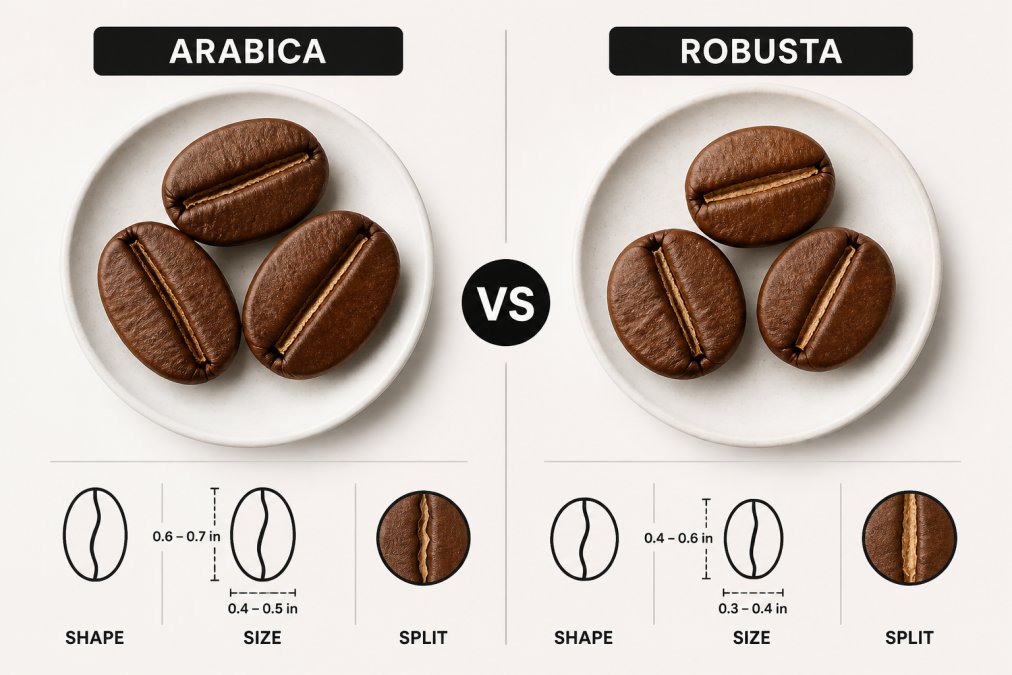
These morphological differences reflect deeper genetic and chemical distinctions that influence roasting, extraction, and taste. Arabica's larger size and lower density mean it roasts more evenly, allowing flavor compounds to develop without burning the exterior. Robusta's denser structure creates a faster roast, resulting in darker, more bitter beans.
Raw arabica beans tend toward a pale greenish-blue hue, while raw robusta skews toward duller gray-green. After roasting, arabica develops varied tones depending on roast level, while robusta tends toward uniform darkness. This visual distinction is one reason specialty roasters favor arabica, it signals quality to consumers.
:::pro When buying whole beans, use morphology as a quick quality check. Uniform bean size and color within a batch suggests careful sorting and processing, indicating the producer cares about quality downstream. :::
Caffeine Content in Arabica vs Robusta
Robusta contains roughly twice the caffeine of arabica. Arabica beans typically contain 1.2-1.5% caffeine by weight, while robusta contains 2.2-2.7% (peer-reviewed research). A single shot of arabica espresso delivers roughly 63-75 milligrams of caffeine, while a robusta shot delivers 120-130 milligrams.
This difference is a survival mechanism. Caffeine is a natural pesticide. Robusta evolved in lower altitudes with higher pest pressure, so the plant developed higher caffeine as chemical defense. Arabica, grown at higher altitudes where pest pressure is lower, never needed that level of production. The trade-off is flavor: caffeine tastes bitter, and robusta's higher content contributes to its characteristically harsh bite.
For caffeine-sensitive drinkers, arabica is the obvious choice. For those seeking maximum energy, robusta delivers a significantly stronger jolt. Many professionals blend the two to balance flavor with caffeine delivery.
Arabica also contains higher levels of chlorogenic acid, a polyphenol with antioxidant properties. When roasted, it contributes to flavor but increases acidity perception. Robusta's lower chlorogenic acid means less acidity and a flatter taste profile.
Flavor Profile of Arabica Coffee and Robusta Comparison
Arabica's flavor profile is why specialty coffee exists as a category. Depending on origin, altitude, and processing, arabica delivers nuanced notes: citrus, stone fruit, floral, chocolate, caramel, honey. The acidity is bright and clean, the body is medium, and the mouthfeel is smooth.
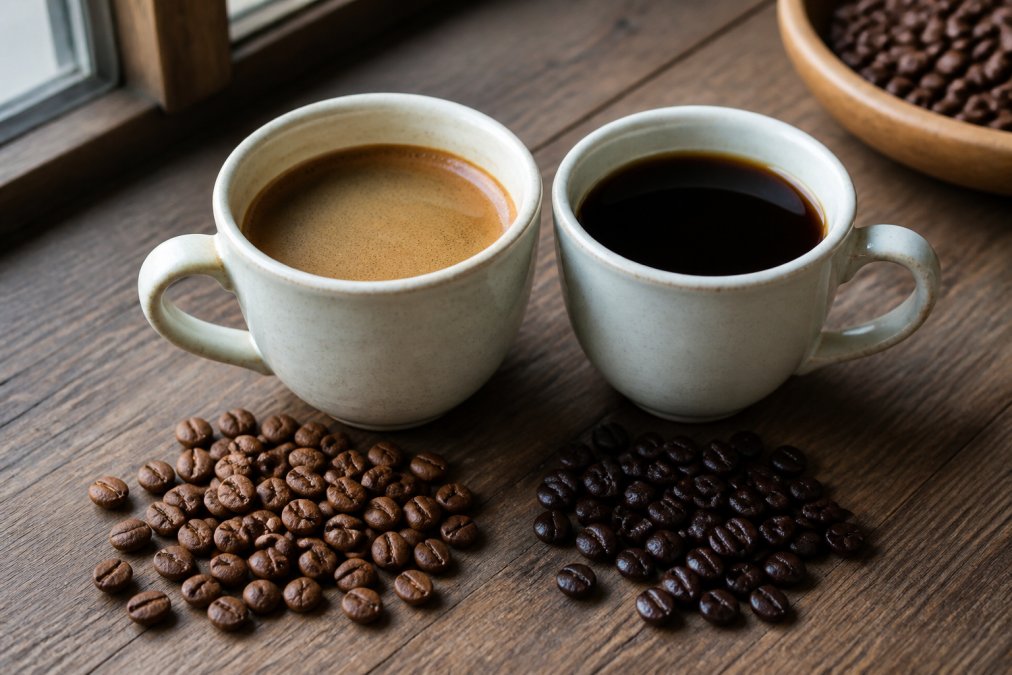
Robusta tastes fundamentally different: bold, bitter, and earthy with notes of wood, tobacco, leather, and dark chocolate. The acidity is low, the body is full and heavy, and the mouthfeel is thick and sometimes astringent. For many accustomed to arabica's subtlety, robusta tastes harsh. But in the right context, a strong espresso, a dark roast, a blend designed for milk, that boldness becomes an asset.
This flavor difference stems from sugar and lipid content. Arabica beans contain roughly 6-9% sugar by weight, while robusta contains only 3-4% (peer-reviewed research). During roasting, sugars caramelize and create sweet, complex notes. Robusta's lower sugar content means fewer caramelization byproducts and a flatter profile. Arabica's higher lipid content (17-18% versus robusta's 10-12%) contributes to richer mouthfeel and better flavor extraction during brewing.
For espresso, robusta has an advantage: it produces significantly more crema, that golden foam on top of a pulled shot. This is why many commercial espresso blends include 20-30% robusta, it's about visual appeal and textural experience.
Best Coffee Beans for Espresso: Which Species Wins
The answer depends on what you value in an espresso shot. If you prioritize flavor complexity and smoothness, arabica wins. If you want bold intensity, crema volume, and caffeine delivery, robusta wins. Most specialty espresso bars use 100% arabica or arabica-dominant blends (85-90% arabica, 10-15% robusta) because flavor is what customers pay premiums for.
Commercial espresso relies heavily on robusta because it tolerates high-volume production, produces abundant crema for visual appeal, and delivers the bitter punch that masks inconsistent brewing and stale beans.
For home espresso brewing, the choice hinges on your equipment and technique. With quality equipment and proper technique, arabica showcases its strengths beautifully. With entry-level equipment, robusta's boldness and forgiving nature may suit you better.
Coffee Depot's 6 Bean Blend is specifically designed for espresso lovers seeking complexity, balancing arabica origins with precise roasting to achieve the full-bodied richness espresso demands while maintaining flavor clarity.

| Characteristic | Arabica | Robusta | Best For Espresso |
|---|---|---|---|
| Crema Production | Moderate | High | Robusta |
| Flavor Complexity | High | Low | Arabica |
| Caffeine Content | Lower | Higher | Robusta |
| Acidity | Bright | Low | Arabica |
| Body | Medium | Full | Robusta |
| Ideal Roast | Light to Medium | Dark | Arabica for flavor, Robusta for intensity |
| Price per Pound | Higher | Lower | Robusta |
Growing Conditions, Altitude, and Environmental Impact
Arabica thrives at high altitude (2,000-6,500 feet) in cool, temperate climates with consistent rainfall and shade. The plant is finicky and vulnerable to pests, diseases, and temperature fluctuations. Major arabica-growing regions include Colombia, Ethiopia, Kenya, Costa Rica, and Central America.
Robusta tolerates lower altitudes (sea level to 2,500 feet) and warmer climates. It's hardy, pest-resistant, and produces higher yields per plant, growing in Vietnam, Indonesia, Uganda, and Brazil where arabica struggles.
Environmental impact differs significantly. Arabica is often grown under shade, preserving biodiversity and preventing soil erosion with less chemical input. Many specialty arabica farms are certified organic or use sustainable practices. Robusta, especially in Southeast Asia, is frequently grown in full-sun monocultures requiring heavy pesticide use. However, robusta's higher yield per plant means less land is needed to produce the same volume, a sustainability advantage.
Climate change is reshaping this calculus. Rising temperatures are making traditional arabica-growing regions less viable. Ethiopia faces drought stress, and Colombia experiences altitude creep. Robusta, being heat-tolerant, may become more economically important as arabica becomes harder to grow in its traditional homes, with serious implications for coffee diversity and farmer livelihoods.
Price, Availability, and Which to Choose for Your Brew
Arabica typically trades at roughly double the price of robusta on the commodity market, reflecting both quality and scarcity. Specialty coffee shops stock almost exclusively arabica, while grocery store coffee and instant coffee often contain significant robusta.
For those seeking to elevate their daily brew, Coffee Depot offers curated blends balancing quality and value. The Best Sellers Sample Pack ($24.99) includes both single-origin arabicas and blends designed for different brewing methods.

If budget is the constraint, robusta delivers more caffeine and bolder flavor at lower cost. If flavor complexity matters, arabica is worth the premium. If you want balance, blends like Coffee Depot's Cowboy Blend ($18.99) or 6 Bean Blend ($18.99) combine arabica's nuance with enough body and boldness to feel satisfying.
Robusta is best for: budget-conscious buyers, dark roast lovers, espresso crema enthusiasts, and anyone seeking maximum caffeine with minimal flavor subtlety.
Blends are best for: remote workers wanting premium quality without obsessive sourcing, busy professionals balancing taste and convenience, and anyone unsure which species suits their palate.
Conclusion
The arabica vs robusta distinction isn't about one being universally "better." It's about understanding what each species delivers and matching it to your priorities. Arabica offers complexity and nuance that makes coffee a ritual. Robusta provides boldness and accessibility that fuels long workdays.
At Coffee Depot, we believe the best coffee experience comes from understanding these differences and choosing intentionally. Whether you prefer arabica's delicate stone fruit notes or robusta's full-bodied boldness, we've curated blends and single-origins that showcase each species' strengths. Our roast-to-order model ensures maximum freshness, and every purchase supports our community through $1 donations per item sold to charity.
Start with our Single Origin Favorites Sample Pack ($24.99) to taste the full spectrum, from bright, fruity arabicas to bold, earthy origins. Or explore our expertly balanced blends like the 6 Bean Blend ($18.99), designed to deliver the complexity arabica lovers seek with the body and intensity that make every cup satisfying. Get started with Coffee Depot and discover why understanding arabica vs robusta transforms how you experience your daily brew.

Frequently Asked Questions
Does Robusta have more caffeine than Arabica?
Yes. Robusta beans contain approximately 2.7% caffeine by weight, nearly double the 1.5% found in Arabica. This higher caffeine content makes Robusta popular for instant coffee and espresso blends where a stronger caffeine kick is desired. However, Arabica's lower caffeine level doesn't mean weak coffee, brewing method, bean freshness, and roast depth significantly impact the final caffeine concentration in your cup.
Why is Arabica coffee more expensive than Robusta?
Arabica costs more due to its superior flavor complexity, lower yield, and stricter growing requirements. Arabica thrives only at higher altitudes (2,000-6,000 feet) in specific climates, making cultivation more challenging and labor-intensive. Robusta grows at lower elevations and tolerates pests better, reducing production costs. Coffee Depot's expertly curated blends, like the 6 Bean Blend at $18.99, balance quality and value by sourcing premium Arabica origins while maintaining accessibility for daily drinkers.
How can you tell the difference between Arabica and Robusta beans visually?
Arabica beans are larger and have an oval, elongated shape with a curved split line down the center. Robusta beans are smaller, rounder, and more stout with a straighter split line. When examining whole beans, Arabica appears more refined and uniform, while Robusta looks more compact. After roasting, these differences remain visible, though less pronounced. Checking the product label or origin information is the most reliable method, reputable roasters like Coffee Depot clearly identify their bean species.
Which coffee bean type should I choose for my home brewing method?
For espresso and concentrated brewing, Robusta's higher body and crema production work well, though many prefer Arabica's nuanced acidity. For pour-over, French press, or drip coffee, Arabica shines with its complex flavor notes and cleaner body. Most specialty blends combine both, Coffee Depot's Best Sellers Sample Pack at $24.99 features diverse roasts that let you explore which species and origin suits your palate. Start with a sample pack to discover your preference before committing to larger quantities.
What makes Arabica coffee have a more complex flavor profile?
Arabica's higher altitude cultivation and slower maturation create more complex sugar and chlorogenic acid development, resulting in nuanced flavor notes like fruit, floral, and chocolate undertones. The bean's higher lipid content contributes to a smoother mouthfeel and more delicate acidity. Robusta, by contrast, develops a bolder, more astringent profile with earthy and woody notes due to its different chemical composition and faster growth cycle at lower elevations.
This article was written using GrandRanker