

Is Social Impact Coffee Really Worth the Price in 2026?
Table of Contents
- What Social Impact Coffee Actually Costs You
- Fair Trade vs Direct Trade Coffee: What the Labels Really Mean
- How to Find Coffee Roasters That Donate to Charity
- How to Verify Coffee Company Charity Claims Before You Buy
- Does Paying More for Social Impact Coffee Guarantee Better Farmer Wages?
- When Social Impact Coffee Is Worth the Price (and When It Isn't)
- Frequently Asked Questions
Last Updated: September 13, 2026
What Social Impact Coffee Actually Costs You
Is social impact coffee really worth the price? For most regular drinkers, yes, provided you verify where the extra money goes. Social impact coffee is coffee sold with a stated commitment to pay producers above commodity rates, fund community projects, or donate a share of revenue to charity. At Coffee Depot, we donate $1 from every item sold to charity, which gives us a clear stake in answering that question honestly rather than dodging it.
The honest answer is that you are paying two separate premiums: one for quality and freshness, and one for the social commitment. Only the first is guaranteed by the roast date on the bag. The second depends entirely on how the roaster structures its giving, which is why the next few sections focus on verification rather than good intentions.
The Price Gap Between Social Impact and Conventional Coffee
The gap is real but smaller than most people assume. Commodity coffee trades on global exchanges where the price swings with weather and currency, and a farmer's share of a grocery-store bag is a thin slice of what you pay at the register. Social impact coffee typically costs more because the roaster pays a fixed premium above that commodity floor, absorbs certification fees, and often funds projects at origin.
What you are not paying for, in most cases, is dramatically better coffee. Freshness and origin quality drive flavor far more than the ethics label does. A conventional single-origin bag roasted last week will usually beat a certified social impact bag roasted six months ago. That distinction matters when you decide whether the premium is buying you something you can actually taste.
Fair Trade vs Direct Trade Coffee: What the Labels Really Mean
Fair Trade is a third-party certification: an independent body audits the supply chain and guarantees a minimum price floor plus a social premium paid to cooperatives. Direct Trade is not a certification at all. It is a claim a roaster makes about buying straight from growers, usually at negotiated prices above the commodity rate, with no external auditor checking the numbers.
That difference is the whole game. Fair Trade gives you a verifiable standard, but the floor is a floor, not a living wage, and the certification cost comes out of someone's margin (fairtradeamerica.org). Direct Trade can pay farmers considerably more because there is no middleman and no certification fee, but it can also mean nothing beyond a marketing line on the bag.
| Model | Who Verifies It | Typical Farmer Benefit | Main Weakness |
|---|---|---|---|
| Fair Trade | Independent certifier | Guaranteed price floor plus social premium | Floor is modest; fees apply |
| Direct Trade | The roaster itself | Negotiated premium, often higher | No outside audit |
| Charity donation | Varies by company | Funds community projects | Unrelated to farmer pay |
The practical takeaway: a Fair Trade logo tells you a standard was met, while a Direct Trade claim tells you what the roaster says it did. Neither guarantees the farmer got rich.
How to Find Coffee Roasters That Donate to Charity
Finding coffee roasters that donate to charity starts with reading the giving model, not the mission statement. Look for a specific mechanism: a fixed amount per bag, a named percentage of profits, or a defined partnership with a named organization. Vague language like "a portion of proceeds" tells you almost nothing.
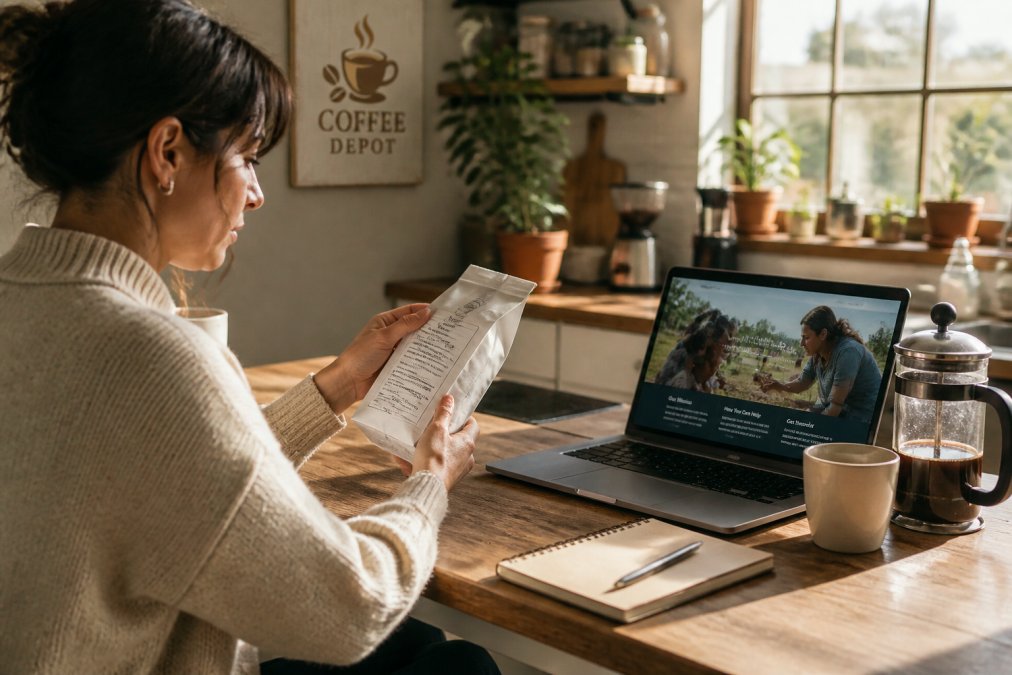
A roaster that donates per item, rather than per quarter, gives you a number you can actually multiply. Coffee Depot takes that approach with $1 from every item sold. When you compare roasters, ask three questions: how much, how often, and to whom. A roaster that answers all three without hesitation is usually the real thing. When you compare roasters, ask three questions: how much, how often, and to whom. A roaster that answers all three without hesitation is usually the real thing.
Red Flags That Signal Empty Promises
- The charity is never named, only described as "partner organizations"
- Donation language appears on the homepage but nowhere in the terms or FAQ
- No annual giving figure is published anywhere
- The "charity" turns out to be the company's own foundation with no public filings
- The social message is louder than any information about the coffee itself
How to Verify Coffee Company Charity Claims Before You Buy
Verifying coffee company charity claims takes about ten minutes and almost nobody does it. Start with the organization's name and search for its registration status. In the United States, most legitimate nonprofits file publicly available annual returns, and a charity that cannot be found in those records is worth questioning.
Next, check whether the roaster publishes a giving total. A company donating a meaningful share of revenue usually wants to talk about the number. If the only evidence is a badge on the product page, treat the claim as unverified. You can also look for third-party seals from organizations that audit corporate giving, or check the IRS Tax Exempt Organization Search to confirm that a named charity actually holds tax-exempt status.
Does Paying More for Social Impact Coffee Guarantee Better Farmer Wages?
No. Paying more does not automatically mean the farmer earns more, and this is where the category's marketing outruns its economics. A higher retail price flows to the roaster, the importer, the exporter, the cooperative, and finally the farm. Each step takes a cut, and a roaster's charitable donation often goes to a community project rather than to the producer's bank account.
The U.S. Department of Agriculture's coffee market reporting tracks how commodity prices move, and those movements explain why a fixed premium matters more than a high sticker price. A roaster paying a stable premium above the market rate gives farmers predictability. A roaster charging more and donating to a school gives farmers nothing directly, though the community may benefit.
So when you evaluate a bag, separate the two claims. Farmer compensation and charitable giving are different promises, and a company can be excellent at one and silent on the other.
When Social Impact Coffee Is Worth the Price (and When It Isn't)
Social impact coffee is worth the premium when three conditions hold: the coffee is roasted recently, the giving model is specific and published, and the roaster pays producers above commodity rates. Miss any one of those and you are mostly buying a story.
It is not worth the premium when you cannot confirm the roast date, when the donation is described only in vague terms, or when the coffee itself is mediocre. Paying more for stale beans with a charity badge is the worst outcome in the category, because you lose on both quality and impact.
The category rewards a small amount of diligence. Check the charity, check the roast date, and check whether the producer premium is stated. Do those three things and the price becomes easy to justify.
Frequently Asked Questions
How can you verify if a coffee company actually donates to charity?
Check the company's website for a named charity partner, not just a vague promise to 'give back.' Look for a specific dollar amount per item or percentage of profits, then cross-reference that charity on Charity Navigator or the IRS Tax Exempt Organization Search. Legitimate social impact coffee brands typically publish annual giving reports or impact summaries. If a company won't name where the money goes, treat the claim as marketing until proven otherwise.
Is fair trade coffee the same as social impact coffee?
No. Fair trade certification sets minimum prices and labor standards for farmers, verified by a third-party certifier. Social impact coffee is a broader term that can include fair trade, direct trade, charitable donations, or community projects. A bag can carry a fair trade label without any charity component, and a brand can donate to charity without being fair trade certified. The two overlap but are not interchangeable, so read the specific claims on each bag.
How much of the price of a bag of coffee usually goes to charity?
It varies widely by brand. Some companies donate a flat amount per item sold, while others give a percentage of profits. There is no industry standard, which is why verifying the claim matters more than assuming a premium price means a large donation. Ask the roaster directly or check their published impact report. If the charity contribution is a flat dollar amount per item, you can calculate exactly what portion of your purchase goes to the cause.
Does paying more for coffee guarantee better wages for farmers?
Not automatically. A higher retail price does not mean the extra money reaches the farm. Fair trade certification sets a price floor for farmers, and direct trade arrangements can pay above market rates, but neither is guaranteed just because a bag costs more. Look for透明度 in the supply chain: named farms, published farmgate prices, or certifications with audited standards. Without that transparency, a premium price may reflect branding and packaging rather than farmer pay.
The real challenge with social impact coffee is not deciding whether to pay more, it is confirming that the extra money does what the label promises. Coffee Depot makes that verification simple: every item sold sends $1 to charity, every order is roasted only after you place it, and every bag ships directly to you at peak freshness. Explore the curated blends and single-serve capsules at Coffee Depot and get coffee worth both the price and the principle.