

Best Coffee Beans for Home Office: 2026 Guide
Table of Contents
- Best Coffee Beans for Home Office: Quick Comparison
- How to Store Coffee Beans for Freshness at Your Desk
- Roast Levels and Flavor Profiles for Your Workspace
- Whole Bean vs. Pre-Ground: What Works at Home
- Best Home Office Coffee Makers and Bean Pairing
- How to Brew Coffee at Your Desk for Maximum Productivity
- Caffeine Content and Timing for Remote Work Focus
- Sourcing and Sustainability: Single-Origin vs. Blends
Last Updated: August 12, 2026
Best Coffee Beans for Home Office: Quick Comparison
Finding the best coffee beans for home office work means balancing freshness, flavor consistency, and brewing convenience. The difference between stale grocery-store beans and freshly roasted specialty coffee is dramatic, one tastes flat and bitter; the other tastes alive with clarity and nuance.
At Coffee Depot, we've spent years curating beans specifically for home office professionals. The key insight most guides miss: your brewing method and workspace constraints should drive your bean selection, not the other way around.
| Roast Level | Best For | Flavor Profile | Caffeine | Storage Life |
|---|---|---|---|---|
| Light | Detail work, morning focus | Bright acidity, origin clarity | Higher | 3-4 weeks |
| Medium | Balanced productivity | Sweetness, body, nuance | Moderate | 3-4 weeks |
| Dark | Bold intensity, low acidity | Smoky, deep, earthy | Slightly lower | 3-4 weeks |
How to Store Coffee Beans for Freshness at Your Desk
The moment roasted beans hit air, they begin losing flavor compounds. Oxygen, light, heat, and moisture are the enemies.
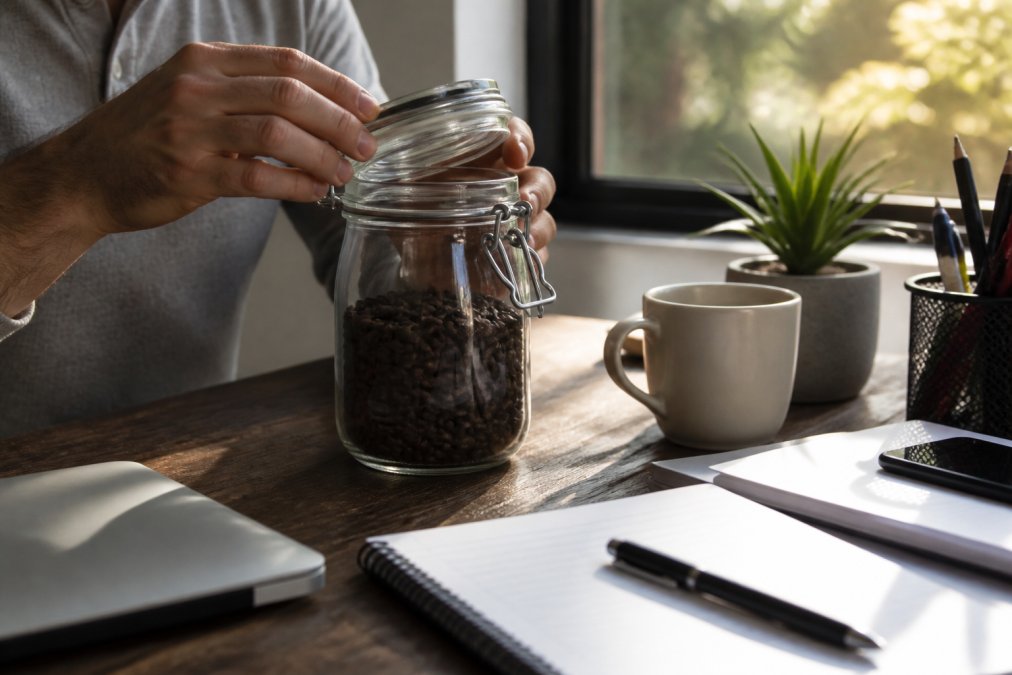
Store beans in an airtight glass container with a rubber seal away from direct sunlight. Keep it in a cool, dark cabinet or drawer, not on your desk counter where temperature fluctuates and light accelerates staling.
Whole beans stay fresh for 3-4 weeks after roasting when stored properly. Pre-ground coffee loses flavor within days because grinding exponentially increases surface area exposed to oxygen. Grinding immediately before brewing makes a dramatic difference.
Temperature stability matters more than people realize. Your home office's consistent 68-72°F conditions are ideal. Avoid storing beans near heat sources, above the refrigerator, or in direct sunlight. Never refrigerate, condensation damages bean structure.
Label your container with the roast date. If you're buying from a specialty roaster, they print this on the bag. Roast date tells you everything; best-by dates tell you nothing useful.
Roast Levels and Flavor Profiles for Your Workspace
Roast level determines flavor intensity, acidity level, and how the coffee pairs with your work style.
Light Roasts: Bright Acidity and Origin Clarity
Light roasts preserve the bean's origin characteristics. You taste the terroir, the specific growing region's soil, altitude, and climate. These beans have higher acidity, which feels bright and clean on the palate.
Light roasts work best for detail-oriented work: writing, coding, design, analysis. They pair excellently with pour-over and drip methods. Single-origin beans shine at light roasts, letting you explore regional variation without committing to subscriptions.
Medium Roasts: Balanced Body and Sweetness
Medium roasts balance acidity and body, offering origin character without the sharp brightness of light roasts, plus deeper sweetness from caramelized sugars. This is the Goldilocks zone for most home office workers.
Medium roasts work across all brewing methods and are forgiving in espresso machines. The flavor profile leans toward chocolate, nuts, caramel, and stone fruit. For sustained focus across 4-6 hours of work, medium roasts deliver consistency without flavor fatigue.
Blends typically work best at medium roast. Coffee Depot's House Blend and Breakfast Blend are medium roasts designed to balance multiple origins into a cohesive cup.

Dark Roasts: Bold Intensity and Low Acidity
Dark roasts prioritize body and intensity. Acidity drops significantly, replaced by smoky, earthy notes. If you find light and medium roasts too sharp, dark roasts eliminate that brightness entirely.
Dark roasts suit bold preferences and work exceptionally well in espresso machines, where their body creates that signature crema layer. Our Cowboy Blend combines dark and medium roasts for a unique profile that bridges intensity and nuance.
Whole Bean vs. Pre-Ground: What Works at Home
Whole beans stay fresh for weeks; pre-ground coffee degrades within days. Grinding breaks down cell walls and exposes the interior to oxygen.
If you're serious about the best coffee beans for home office use, whole bean is non-negotiable. A basic burr grinder costs $30-50 and transforms your coffee experience. Grinding 30 seconds before brewing takes negligible time and delivers dramatically better flavor.
Best Home Office Coffee Makers and Bean Pairing
Your brewing equipment determines which beans perform best.
Espresso Machines and Dense-Crema Blends
Espresso machines force hot water through finely ground coffee under pressure. This extraction method demands beans with body and density. Dark roasts and medium-dark blends create that signature crema layer and full mouthfeel.
Espresso blends are specifically formulated for this method, combining robusta beans (which create crema) with arabica beans (which add flavor). Coffee Depot's 6 Bean Blend is a dark roast espresso blend designed for machine extraction.

Drip Coffee Makers and Balanced Medium Roasts
Drip makers use gravity to pull water through grounds over 4-6 minutes. This slower extraction favors medium roasts that balance acidity and body. The long contact time means over-extraction is possible, so slightly coarser grind sizes prevent bitterness.
Coffee Depot's Breakfast Blend is engineered for drip machines and tastes balanced, slightly sweet, and never harsh across a full pot.
Pour-Over and Single-Origin Beans
Pour-over puts you in control of water temperature, pour rate, and brew time. This precision allows single-origin beans to express their full character.
Light and medium roasts excel in pour-over. The method's clarity lets you taste subtle flavor notes that espresso and drip sometimes mask. Coffee Depot's Single Origin Favorites Sample Pack gives you six 2-ounce pours to explore different origins without committing to full-size bags.
How to Brew Coffee at Your Desk for Maximum Productivity
Brewing quality matters as much as bean quality.
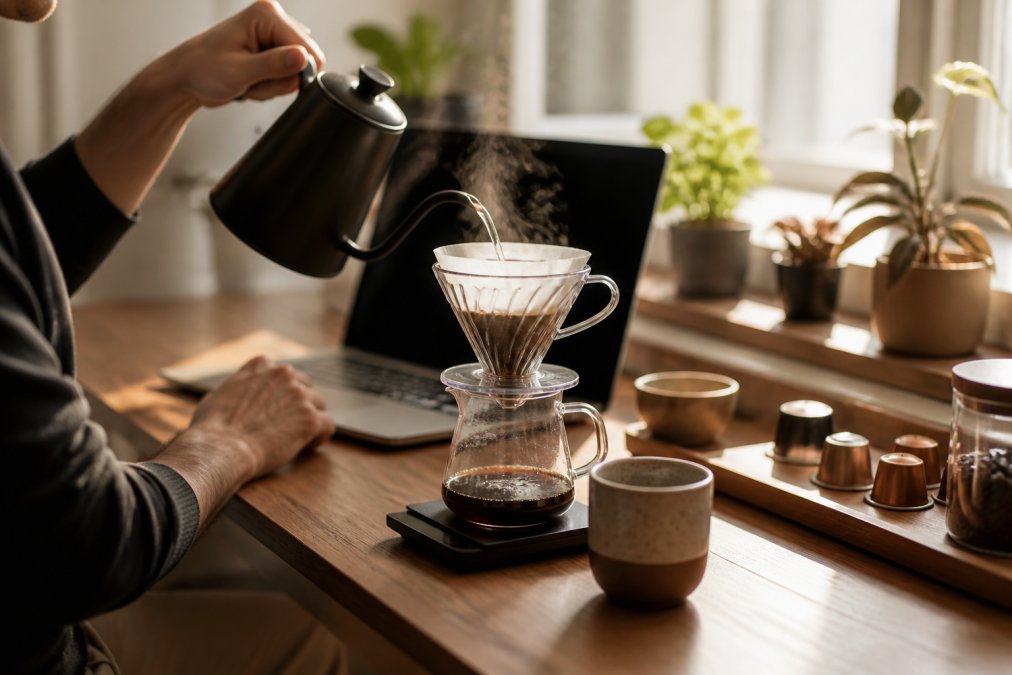
Water temperature is critical. Ideal brewing temperature is 195-205°F. Boiling water (212°F) over-extracts and tastes bitter. An electric kettle with temperature control ($25-40) solves this completely.
Brew time depends on method: espresso 25-30 seconds, drip 4-6 minutes, pour-over 3-4 minutes. Timing consistency matters more than hitting exact seconds.
Water quality affects taste. If your tap water is heavily chlorinated or mineral-heavy, consider filtered water. A basic pitcher filter works and makes a noticeable difference.
Grind size must match your method. Espresso requires fine grind (powder-like); drip requires medium grind (sand-like); pour-over requires medium-fine grind.
Brew ratio (coffee to water) affects strength and flavor balance. Standard is 1:16 (1 gram coffee to 16 grams water). A simple kitchen scale ($15) lets you dial this in precisely.
Caffeine Content and Timing for Remote Work Focus
Caffeine timing matters more for remote work than traditional office work. Light roasts have slightly more caffeine than dark roasts, but the difference is under 5%.
A typical 8-ounce cup of brewed coffee contains 80-100mg of caffeine. Espresso (1-ounce shot) contains 60-75mg. These amounts are consistent across roast levels.
Caffeine half-life is 4-6 hours. If you drink coffee at 9am, half the caffeine remains at 1-3pm. This explains afternoon crashes.
For sustained focus, drink coffee during your peak work windows and avoid it 6+ hours before sleep. Many remote workers find two coffee windows optimal: one at 7-8am for morning focus, another at 11am-12pm for afternoon energy. This avoids the 3pm crash and allows sleep by 10-11pm.
Sourcing and Sustainability: Single-Origin vs. Blends
Single-origin beans come from one specific region or farm. Blends combine beans from multiple origins.
Single-origin beans let you taste terroir. A Kenyan single-origin tastes different from an Ethiopian single-origin, even at the same roast level. Blends combine origins to create balanced flavor profiles. A blend might use Brazilian beans for body, Kenyan beans for brightness, and Central American beans for sweetness. Blends are more forgiving than single-origins and tend to be more affordable.
Fair trade and organic certifications matter if sustainability is important to you. These certifications cost more but support better farming practices and healthier ecosystems.
Coffee Depot's Best Sellers Sample Pack includes both single-origins and blends, letting you compare approaches side-by-side.

Finding the best coffee beans for home office work means matching bean characteristics to your equipment, storage setup, and work rhythm. Freshness matters most, buy from roasters who roast to order and ship immediately.
Start with Coffee Depot's sample packs to explore roast levels and origins without buying full-size bags. Their direct-roast model ensures maximum freshness, and the $1 charitable donation per item means your coffee habit supports community causes.
Frequently Asked Questions
What makes the best coffee beans for a home office environment?
The best coffee beans for home office use balance freshness, flavor consistency, and compatibility with your brewing equipment. Look for whole beans roasted within 2-4 weeks of purchase, with a roast date clearly marked on the bag. Medium roasts work well for most office settings because they offer balanced body and acidity without overwhelming your workspace. Coffee Depot's roast-to-order approach ensures maximum freshness since beans are roasted after you place your order and shipped directly to you.
How long do coffee beans stay fresh for home office use?
Whole coffee beans remain at peak freshness for 2-4 weeks after roasting when stored properly in an airtight container away from heat and light. Pre-ground coffee loses freshness much faster, typically within 1-2 weeks. For remote workers who brew daily, buying smaller quantities more frequently or opting for roast-to-order services maintains optimal flavor. Storing beans in a cool, dark cupboard or sealed container extends shelf life significantly compared to leaving bags open on a desk.
Should I buy whole bean or pre-ground coffee for my desk?
Whole beans are superior for home office use because they retain flavor and aroma much longer than pre-ground coffee. Grinding beans just before brewing unlocks the full flavor profile and produces better extraction in any brewing method. If convenience is your priority, buy whole beans and grind them at home using a burr grinder. Pre-ground coffee works only if you brew within days of opening the bag, making it less practical for regular home office use.
How does caffeine content vary between coffee roast levels?
Contrary to popular belief, light roasts contain slightly more caffeine than dark roasts because the roasting process reduces caffeine content. However, the difference is minimal, about 5% less in dark roasts. For remote work productivity, focus on brew method and bean density instead. Espresso-roasted beans (typically dark) are denser and produce more concentrated caffeine per shot, while drip coffee from medium roasts delivers steady energy over a longer period, better suited for sustained office focus.
This article was written using GrandRanker