

Are Single Serve Coffee Capsules Recyclable? Facts
Table of Contents
- Are Coffee Capsules Recyclable? The Short Answer
- Why Curbside Recycling Rejects Most Coffee Capsules
- How to Recycle K-Cups Step by Step
- Nespresso Recycling Program: What You Need to Know
- Compostable Coffee Pods vs Plastic: Which Is Better?
- Creative Ways to Reuse Coffee Capsules at Home
- The Bottom Line on Coffee Capsule Recycling
- Frequently Asked Questions
Last Updated: September 6, 2026
Are Coffee Capsules Recyclable? The Short Answer
Whether single serve coffee capsules are recyclable has no simple yes or no answer. Most plastic capsules are technically recyclable but practically end up in landfills because curbside programs reject them. They are recyclable only when you follow specific preparation steps or use a dedicated take-back program, which we break down in this guide from Coffee Depot.

At Coffee Depot, we believe great coffee should not come at the cost of the planet, so we have analyzed the recycling landscape for single-serve pods to give you clear, actionable answers. The core issue is that a standard plastic pod combines multiple materials: a polypropylene plastic cup, an aluminum foil lid, and coffee grounds. This material separation challenge is why most municipal recycling programs will not accept them as-is.
Below, we show you exactly how to recycle K-Cups, explain how the Nespresso recycling program works, and compare compostable coffee pods vs plastic. But first, here is what most guides get wrong: they tell you to toss pods in the bin without explaining why sorting facilities reject them.
Why Curbside Recycling Rejects Most Coffee Capsules
Curbside collection programs reject most coffee capsules because of physical size, material composition, and the economics of modern sorting facilities. Understanding the mechanism is the first step to seeing why the bin is not the answer.
The Size Problem: Falling Through the Cracks
At a typical Material Recovery Facility (MRF), recyclables move along a conveyor belt through screens and sorters. The first step is usually a disc screen or trommel that separates items by size. Most MRFs are calibrated to capture containers larger than roughly 3 to 4 inches in their smallest dimension. A standard K-Cup pod is about 2 inches tall and 1.5 inches in diameter, smaller than the minimum threshold for capture, so it falls through the screen gaps and ends up in the residual waste stream sent to a landfill or incinerator.
The Contamination Problem: Mixed Materials and Coffee Grounds
Even if a pod is large enough to be captured, it presents a contamination issue. A single-serve capsule is a composite item: a #5 polypropylene plastic cup, an aluminum foil lid, and residual coffee grounds. At the MRF, optical sorters use near-infrared sensors to identify plastics by resin type. A pod with its foil lid still on reflects light differently, confusing the sensor and causing misclassification. If crushed or torn, the coffee grounds spill out and contaminate the surrounding stream of paper and plastic, reducing the value of the entire bale. For this reason, most MRF operators consider pods a 'contaminant' rather than a recoverable material.
The Economic Reality: Cost of Separation vs. Value of Material
Recycling is an economic equation. The cost to manually pick pods off a sorting line, separate the plastic from the aluminum, and clean the coffee residue far exceeds the market value of the recovered polypropylene. Virgin #5 plastic sells for roughly $0.50 to $0.70 per pound, while contaminated post-consumer plastic can be worth less than half that. Municipalities across the United States, from Los Angeles to smaller Midwest towns, have consistently updated guidelines to explicitly exclude single-serve pods from curbside bins for this reason. The Association of Plastic Recyclers has also issued guidance noting that items smaller than 2 inches are not reliably recoverable (plasticsrecycling.org).
The Exception: When Curbside Programs Do Accept Them
A small but growing number of municipalities have begun accepting pods in curbside programs, but only under strict conditions. Some cities in California and the Pacific Northwest now allow pods if the consumer removes the lid, empties the grounds, and rinses the cup. These programs typically require the pod to be placed loose in the bin, never bagged, and rely on newer optical sorters that can recognize small #5 plastics. If you live in one of these areas, the preparation steps in the next section are mandatory, not optional. If unsure whether your city is one of them, the safest assumption is that your curbside program does not accept pods.
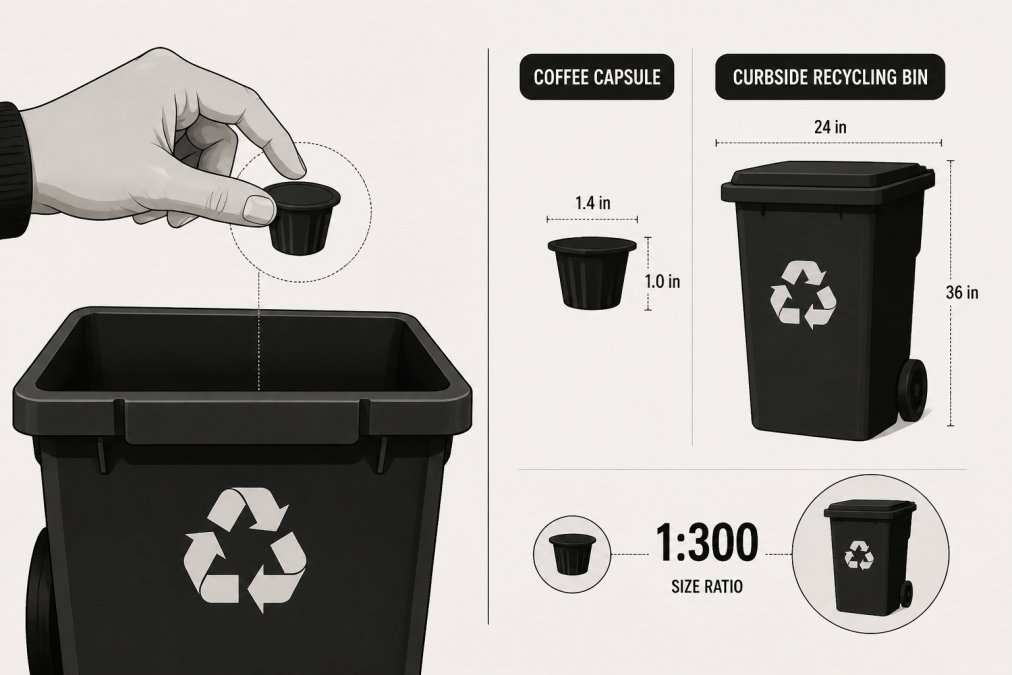
Curbside recycling is designed for large, clean, single-material containers. Coffee capsules violate all three criteria, which is why the vast majority of the 60 billion pods produced annually in the United States end up in landfills. The solution is not to hope the system changes, but to use the dedicated programs and manual methods outlined in the rest of this guide.
How to Recycle K-Cups Step by Step
Recycling K-Cups at home requires manual disassembly, which is tedious but effective. The process takes about 30 seconds per pod and involves separating the three components so each can enter the correct recycling program.
- Cool the pod completely after brewing to avoid burns.
- Peel off the aluminum foil lid and rinse it to remove coffee residue.
- Empty the coffee grounds into your compost bin or trash.
- Rinse the plastic cup thoroughly to remove any remaining grounds.
- Check the number on the bottom of the cup. Most are #5 polypropylene plastic.
- Place the lid and cup into your recycling bin if your local program accepts #5 plastic.
- Confirm your municipality accepts small plastics, as many do not.
The coffee grounds are the easiest part to manage since they are organic and can go straight into a compost pile. This manual approach is the most reliable method for consumers who want landfill diversion without relying on a manufacturer program.
Nespresso Recycling Program: What You Need to Know
The Nespresso recycling program is the most established capsule take-back scheme in the industry, offering free collection through UPS drop-off and mail-in bags. Nespresso designed their aluminum capsules so they can be recycled indefinitely without quality loss, and their program accepts both aluminum and the newer compostable paper-based pods (nespresso.com).
To participate, you collect used capsules in the provided recycling bag, then either drop it at a UPS location or schedule a pickup. Nespresso processes the aluminum through smelting, which separates the coffee grounds for composting and converts the metal into new products like bike frames and watch cases. This circular economy approach keeps the material out of the waste stream entirely.
The Regional Reality: Why One Program Does Not Fit All
While the Nespresso program is excellent, it is only one piece of a fragmented recycling landscape. Across the United States, recycling capabilities vary wildly by municipality. A program that works in Portland, Oregon, may not exist in rural Texas. This variability is the single biggest source of confusion for consumers trying to do the right thing. The key is to build a 'check your local rules' framework rather than assuming a national standard exists.
How to Check Your Local Rules in Three Steps
Step 1: Identify Your Waste Hauler. Your local rules are set by your city or county, but often enforced by a private waste management company like Waste Management, Republic Services, or a smaller regional hauler. Look at your utility bill or your hauler's website to find out who actually picks up your recycling.
Step 2: Search for Specific Terms. Do not search for 'recycling near me', that returns generic results. Instead, search for '[your city name] + coffee pods recycling' or '[your hauler name] + single serve capsules'. Many municipalities now have specific pages addressing pods because the question is so common. For example, the City of Seattle's public utilities page explicitly states that pods are not accepted in curbside bins, while the City of Austin provides a list of drop-off locations for pod recycling.
Step 3: Look for Manufacturer Take-Back Partnerships. Many local recycling centers partner with manufacturers to accept pods that would otherwise be rejected. For instance, some Whole Foods locations in the Northeast have collection bins for Nespresso pods, and certain municipal hazardous waste facilities accept pods during special collection events. Earth911.com maintains a searchable database of drop-off locations by ZIP code, a reliable resource for finding a nearby collection point.
What to Do If Your Local Program Does Not Accept Pods
If your municipality and hauler do not offer a pod recycling option, you have two practical paths. The first is to use a mail-in program. Beyond Nespresso, companies like Terracycle offer zero-waste boxes for coffee capsules that you can fill and ship back. These boxes cost around $80 to $100 and hold roughly 200 to 300 pods, making them viable for heavy users. The second path is to switch to a pod brand that offers its own take-back program.
The Bigger Picture: Brand Responsibility vs. Consumer Responsibility
For consumers using other pod brands, the challenge is that most manufacturers do not offer equivalent take-back infrastructure. This is where the environmental impact of single-serve coffee becomes a brand responsibility question, not just a consumer one. When a brand sells pods without a take-back program, they are effectively externalizing the waste management cost to the consumer and the municipality. The most sustainable choice is to support brands that either offer a closed-loop recycling program or use materials compatible with local composting infrastructure. This regional variability is why the answer to 'are single serve coffee capsules recyclable' is always: 'It depends on where you live and which brand you buy.'
Compostable Coffee Pods vs Plastic: Which Is Better?
Compostable coffee pods vs plastic is not a fair comparison when you look at the full life cycle. Compostable pods, typically made from plant-based materials, break down in industrial composting facilities within 12 weeks, while plastic pods persist for hundreds of years. However, compostable pods only deliver their benefit if your local waste management system actually processes industrial compost.
A Life Cycle Assessment comparison reveals that aluminum capsules with a take-back program often have a lower environmental footprint than plastic pods, because aluminum recycling is highly efficient and the material retains its value. Plastic pods sit in the middle: they are lightweight and cheap to produce, but their recyclability is mostly theoretical given current sorting infrastructure.
| Pod Type | Material | Disposal Method | Environmental Impact |
|---|---|---|---|
| Plastic | Polypropylene | Manual disassembly or landfill | Persists for centuries |
| Aluminum | Recyclable metal | Manufacturer take-back | Infinite recyclability |
| Compostable | Plant-based bioplastic | Industrial composting | Breaks down in weeks |
The key takeaway is that the best choice depends on your local infrastructure. If you have access to industrial composting, compostable pods are the clear winner. If you do not, an aluminum pod with a take-back program beats plastic every time.
Creative Ways to Reuse Coffee Capsules at Home
Before you toss another pod, consider that these small containers have surprising second lives. Upcycling and reuse hacks for coffee capsules range from practical organization to small-scale gardening projects.
Plastic pods work well as seed starters for seedlings because they are the perfect size for a single sprout. Punch a drainage hole in the bottom, add soil, plant your seed, and transplant the whole thing once the seedling is established. The aluminum foil lids can be cleaned and used as tiny paint palettes for craft projects or as protective covers for small containers.
For the more ambitious, a collection of pods can become a jewelry organizer, a desk drawer divider, or even a small wall planter for herbs. The point is that reuse extends the useful life of the material and delays its entry into the waste stream, which is the most effective form of waste reduction.
The Bottom Line on Coffee Capsule Recycling
Coffee capsule recycling is possible, but it requires effort beyond the curbside bin. The most straightforward path is to check whether your pod manufacturer offers a take-back program, and if not, commit to the manual disassembly process outlined above.
For coffee enthusiasts who want to minimize waste without sacrificing quality, choosing a roaster that prioritizes sustainability matters. At Coffee Depot, our single-serve capsules are crafted for freshness, with coffee roasted only after you order and shipped directly to your door. We donate $1 from every item sold to charity, so your daily brew supports both your palate and your community.
The bottom line is that single serve coffee capsules are recyclable when you take responsibility for the material separation. Whether you choose compostable pod alternatives or commit to a manual recycling routine, your choices reduce the environmental footprint of your daily cup. Explore our 12 Pack Single Serve Coffee Capsules to enjoy premium coffee with a cleaner conscience.
Frequently Asked Questions
Can Keurig coffee pods be recycled in curbside bins?
Most curbside programs do not accept K-Cup pods because of their small size and mixed materials. The plastic shell, aluminum foil lid, and coffee grounds must be separated before recycling. Even then, many material recovery facilities lack the sorting infrastructure to capture items smaller than about 2 inches. Check your local municipal guidelines, but plan on using a specialized program or manual separation for most K-Cup recycling.
Do I need to clean coffee pods before recycling them?
Yes. Coffee grounds contaminate the recycling stream, so you must empty and rinse the pod before recycling the plastic or aluminum components. Remove the foil lid, dump the grounds into compost or trash, and give the empty cup a quick rinse. Dry the pieces before placing them in your recycling bin. Skipping this step can cause an entire batch of recyclables to be sent to a landfill.
Are compostable coffee pods a better alternative to plastic?
Compostable coffee pods break down faster than plastic versions, but only if they reach an industrial composting facility. Home compost piles rarely reach the temperature needed to break down PLA-based pods. If your city offers industrial composting, these pods divert waste effectively. Without that infrastructure, compostable pods may still end up in a landfill, where they decompose slowly without oxygen.
What is the best way to dispose of Nespresso pods?
Nespresso's recycling program is the most reliable option. The company provides prepaid recycling bags that you fill with used pods and drop off at UPS locations or schedule for pickup. Nespresso separates the aluminum and coffee grounds at their facilities, recycling the metal and composting the grounds. This program accepts both aluminum and plastic Nespresso-brand pods at no cost to you.
Recycling coffee capsules takes a few extra minutes, but the environmental payoff is worth the effort. Coffee Depot makes it easy to enjoy exceptional coffee while supporting sustainable habits, with roast-to-order freshness and a $1 donation per item to charity. Get started with Coffee Depot and turn your daily brew into a moment of joy that gives back.